Last week, we published a prediction before the NFL had given us a single snap of evidence. Using the Waiver-Frenzy Score, we froze the three players we believed would set off the biggest post–Week 1 waiver frenzy — Dontayvion Wicks, George Holani and Malik Washington — and put them on the record before kickoff. That was the experiment on hard mode: no box scores, no usage, no injuries, just an attempt to forecast the market blind. The score wasn't designed to name the highest-scoring players, and it wasn't recommending who you should add. It was trying to predict the market.
The games have now been played, and that flips the exercise entirely. Today's predictions are the opposite of last week's — we're no longer guessing what Week 1 might produce, we're reacting to what it did. In theory, that should make the market easier to read. Whether last week's blind version actually worked is a question we answer tomorrow, not today.
From here, the column settles into a simple rhythm. Tuesday is the forecast: we predict the three eligible players we think fantasy managers will add most aggressively, then separately use the framework to choose the three we think managers should add. Wednesday is the audit: once the waiver market has moved, we grade what managers actually did and run the players they actually chased through the same Role Verdict framework. Then, one week later, we come back to today's recommendations and ask whether the roles we bought survived another game. The market prediction gets graded almost immediately; the recommendation gets graded after we get more football. Neither gets quietly walked back.
The lesson from our historical study wasn't that Week 1 breakouts are meaningless. It was that the type of breakout matters. Before we care about the box score, we want to know whether the player was actually on the field, whether he received meaningful opportunity, whether the opening is likely to persist and whether he appears to own it.
Or, more simply: Did Week 1 reveal new information about who owns the opportunity?
That's what we're testing now. And we're keeping the eligibility rule from the original exercise: RBs, WRs and TEs rostered in no more than 50% of ESPN leagues. We froze the eligibility snapshot before publishing rather than letting Tuesday's waiver movement change the player pool. ESPN rostership at the snapshot: Malik Washington 7.7%, Devaughn Vele 12.9%, Kaelon Black 15.4% and Caleb Douglas 15.6%. All four comfortably clear the line. (Eligibility snapshot: Monday, Sept. 14.)
Before We Start: The Coker Problem
Jalen Coker would be one of the most interesting players in this column. Eight catches, 138 yards and two touchdowns on nine targets — and, more importantly, real opportunity underneath the production. This wasn't two long scores on three targets.
There's just one problem: Coker was rostered in 50.7% of ESPN leagues at our snapshot — barely above the line, but above it. So he's out. If Coker happens to be available in your league, add him. This isn't an argument against the player; it's the rule doing its job.
The same rule takes out Carnell Tate. He was rostered in roughly 93% of ESPN/Yahoo leagues entering the Week 1 results window, far above the cutoff. His Week 1 usage is exactly the kind of quiet role we'd otherwise want to evaluate, but the framework never gets to weigh in on a player almost nobody can add.
No exceptions.
PART I: WHO WE THINK EVERYONE WILL ADD
1. Devaughn Vele, WR, Saints
If we're predicting fantasy-manager behavior rather than prescribing it, Vele is the logical place to start. A line of seven catches, 69 yards, a touchdown and nine targets is exactly the kind of Week 1 line that creates a Tuesday-morning waiver rush.
Unlike plenty of opening-week breakouts, there's legitimate usage underneath it. Using one consistent RotoWire Week 1 dataset, Vele played 91% of New Orleans' offensive snaps, ran a route on 81% of team dropbacks and drew a 17.6% target share. He also stayed on the field with Chris Olave in two-receiver sets. With Jordyn Tyson on injured reserve, Vele is the Saints' clear No. 2 receiver for now.
There are reasons for caution. New Orleans played an extreme-volume overtime game and attempted 56 passes. That should not be projected forward. But those are questions for Part II. For now we're predicting the market, and the market sees nine targets, seven catches and a touchdown from a widely available receiver.
Prediction: Vele finishes as the most aggressively added eligible RB, WR or TE of the Week 2 waiver cycle.
2. Caleb Douglas, WR, Dolphins
Douglas is where the distinction between predicting the market and evaluating it starts getting interesting. The rookie caught five passes for 94 yards in his NFL debut. That's the number fantasy managers will notice.
There's real usage underneath it, too. RotoWire charted Douglas for 90% of Miami's offensive snaps, 31 routes — an 86% route rate — seven targets and a 25.9% target share. The Dolphins did not treat the third-round rookie like a developmental piece stealing a few snaps.
That's enough to generate a waiver rush. Whether it is enough to earn one of our three recommendation spots is a different question.
Prediction: Douglas finishes second among our eligible waiver additions.
3. Kaelon Black, RB, 49ers
Black might be the most fascinating player in this entire exercise. Christian McCaffrey didn't leave Week 1 with an injury that handed Black the backfield. San Francisco simply played him.
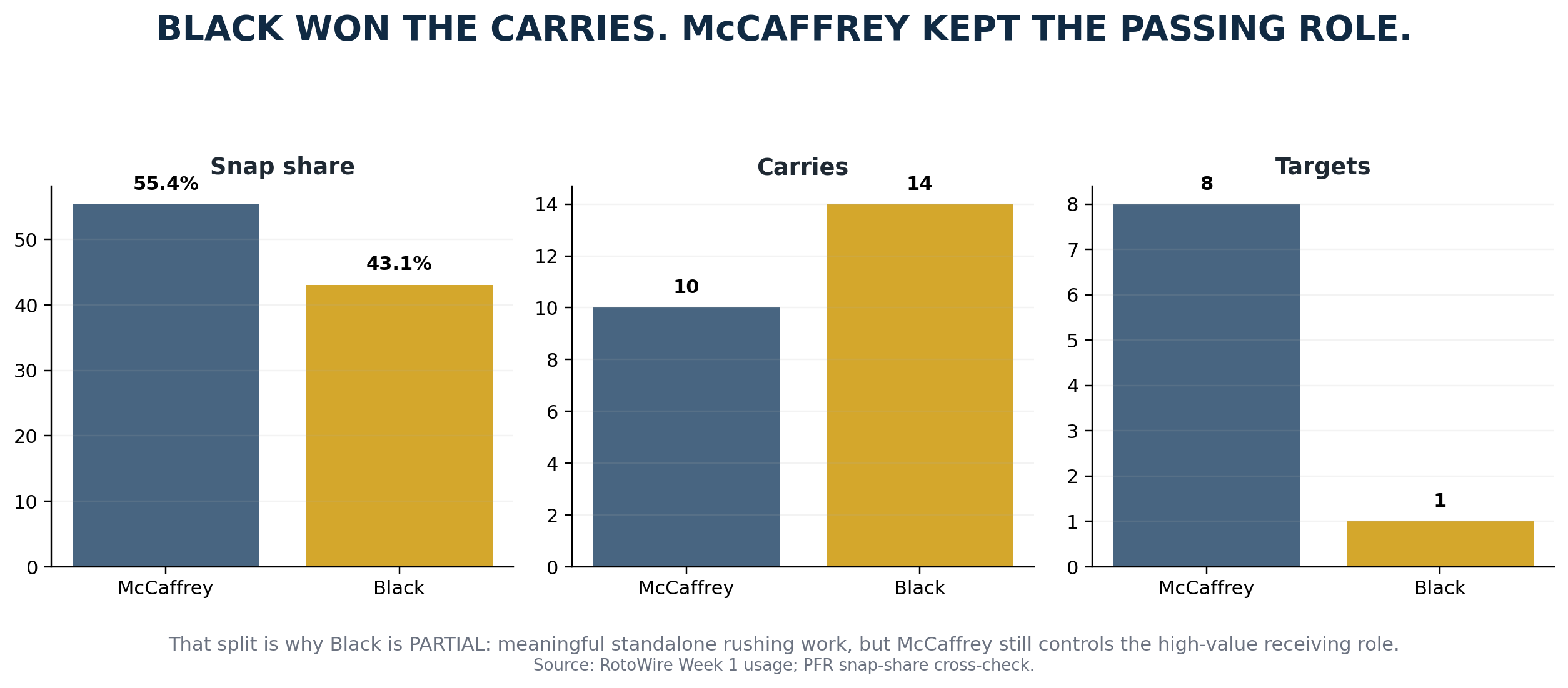
Black carried 14 times for 65 yards, caught another pass for five and played 43.1% of the offensive snaps. McCaffrey finished with 10 carries and five receptions. Fifteen touches behind Christian McCaffrey is going to get attention regardless of the explanations surrounding the game.
There's also another factor lurking underneath Black's appeal that we'll return to shortly: San Francisco spent the offseason talking about reducing McCaffrey's enormous workload.
Prediction: Black finishes third among our eligible waiver additions.
PART II: WHO YOU SHOULD ACTUALLY ADD
This is where the exercise finally creates real disagreement. Our market prediction stays frozen: Vele → Douglas → Black. We are not changing it because deeper analysis uncovered a player we like more. But the recommendation board is allowed to disagree with the market — that is the entire reason this section exists.
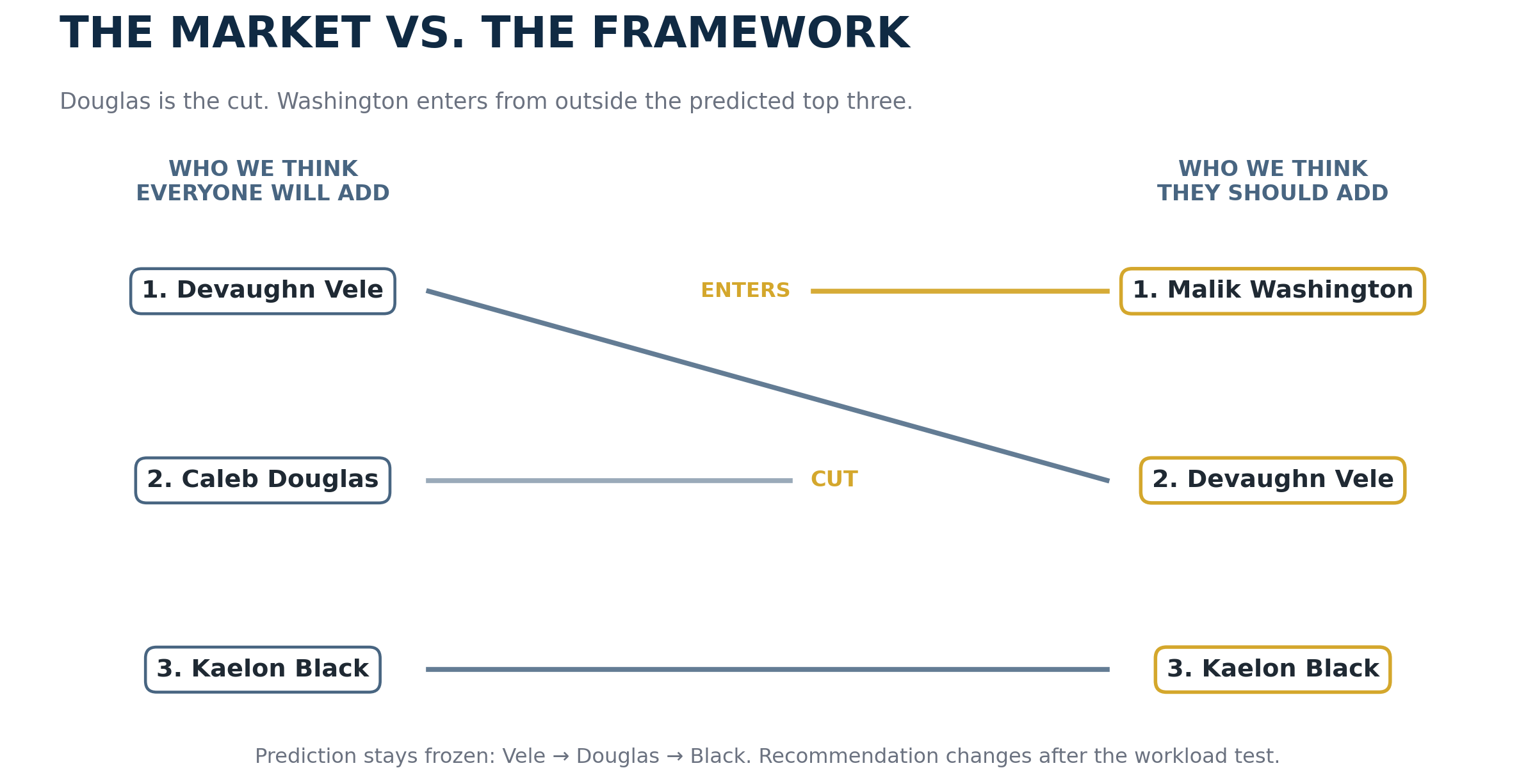
The framework replaces Douglas with Malik Washington. That is not because Douglas had a bad Week 1. It is because forcing ourselves to recommend only three players creates a direct test of the premise: when the box score and the workload point in different directions, which one do we trust?
The Framework, Briefly
REAL: Week 1 revealed strong evidence of a meaningful role. PARTIAL: Week 1 revealed meaningful opportunity, but ownership or durability remains unresolved. MIRAGE: the fantasy result was substantially louder than the underlying role evidence.
Diagnosis isn't enough. After assigning the Role Verdict, we test whether the opening is secure, whether the player actually owns the opportunity or still faces meaningful competition, and what kind of upside that role creates. The prescription is the action: PRIORITY, CONDITIONAL or CAUTION.
In our 30-player historical sample, Priority cases became League Winners or Hits 8 of 11 times, Conditional cases 4 of 7 and Caution cases 3 of 8. Those are in-sample descriptions, not predictive hit rates. This week is the first real out-of-sample test.
The Workload Test: Washington vs. Vele vs. Douglas
Before ranking the receivers, we standardized the comparison. The graphic below uses the same RotoWire Week 1 charting methodology for all three players, rather than mixing route definitions from different providers. That lets us compare the underlying work on equal terms.
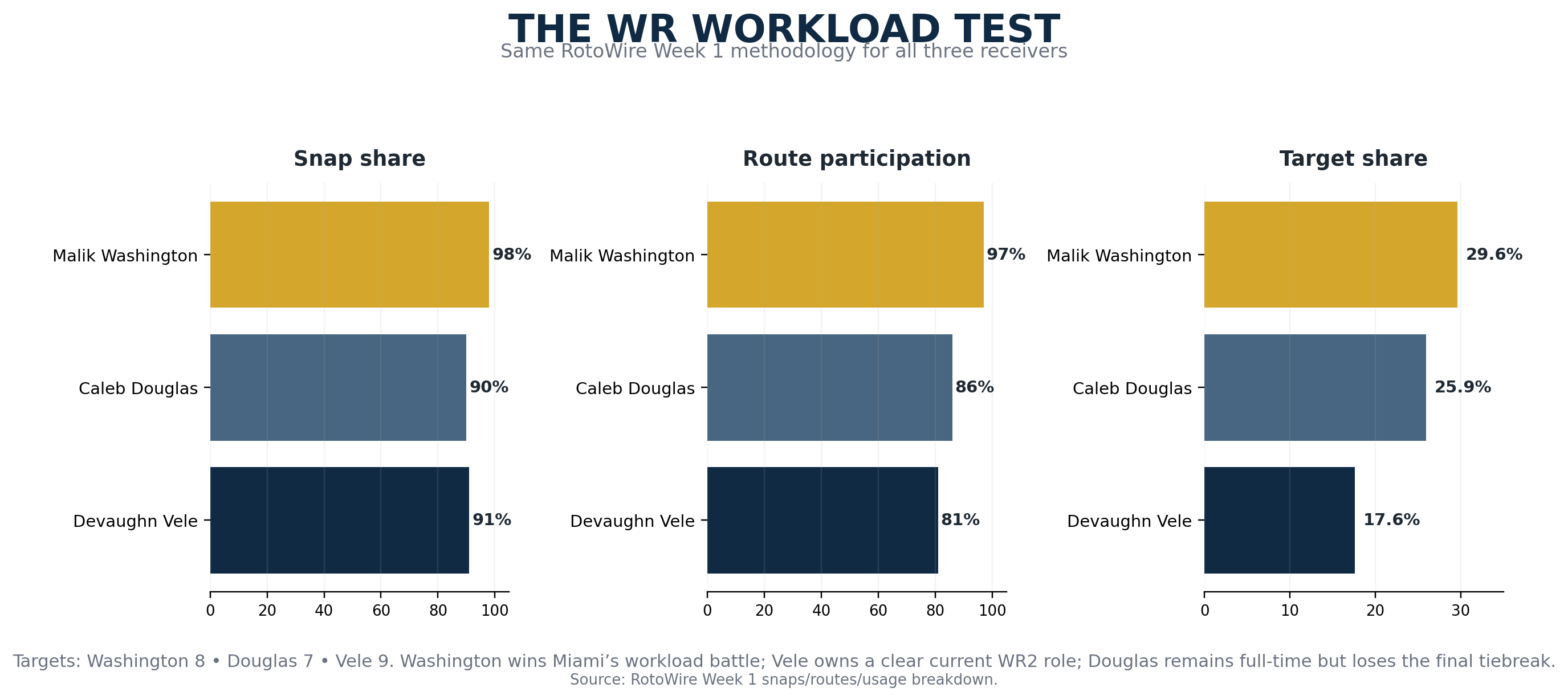
Washington has the strongest pure participation profile: 98% of Miami's snaps, a 97% route rate, eight targets and a 29.6% target share. Douglas was also a full-time player — 90% of snaps, 86% routes, seven targets, 25.9% target share — but Washington beat him in every basic opportunity measure on the same team, in the same game, with the same quarterback. Both were targeted on 23% of their routes. Douglas won the box score, 94 receiving yards to 53; Washington won the workload.
Vele's profile is different. His 81% route participation trails both Miami receivers, but he played 91% of New Orleans' snaps, led Saints wideouts in route rate and drew nine targets. His current WR2 role is clear while Tyson is sidelined. The caveat is team volume: the Saints' Week 1 passing environment was extreme, so the raw nine-target total is more likely to fall than the role itself.
1. Malik Washington, WR, Dolphins — ROLE VERDICT: REAL
Washington is the uncomfortable recommendation — which is exactly why he belongs at No. 1. His Week 1 fantasy line, three catches for 53 yards, is the least exciting of the three receivers we're evaluating. The workload underneath it is the strongest.
Test the opening. Washington's opportunity was organic, not created by a teammate leaving the game. He played 98% of Miami's snaps and ran a route on 97% of dropbacks. There is no obvious returning starter who automatically erases that role. Opening: SECURE.
Test ownership and competition. Douglas is real competition, and this is not an argument that Washington has locked down a dominant target share. But Week 1 gave Washington eight targets and a 29.6% target share, both slightly ahead of Douglas. On a team with an unsettled receiving hierarchy, Washington was the player Miami kept on the field almost every play. Ownership: STRONGEST CURRENT EVIDENCE IN MIAMI.
Price the upside. Washington does not have Douglas's Week 1 yardage spike, and outside analysts may prefer Douglas's ceiling. Our framework is deliberately weighting the work first. If Washington continues to play every snap and earn targets at this rate, the fantasy points have multiple ways to follow.
PRESCRIPTION: PRIORITY — No. 1 waiver claim. The box score is modest. The role is not.
2. Devaughn Vele, WR, Saints — ROLE VERDICT: REAL
Vele stays on the recommendation board because the role is more secure than the earlier draft gave it credit for. He played 91% of the snaps, led Saints receivers with an 81% route rate and drew nine targets. That is a starting receiver role, not a touchdown-driven mirage.
Test the opening. Tyson is on injured reserve and must miss at least four games; current reporting has Vele functioning as the Saints' WR2 until at least mid-October, possibly longer. That is enough runway to matter in fantasy. We're diagnosing the role that exists while the opening exists; Tyson's eventual return affects durability, not whether Vele currently owns the job. Opening: SECURE MULTIWEEK.
Test ownership and competition. Olave remains the alpha target earner, but Vele was comfortably ahead of the next Saints receiver in route participation and was on the field with Olave in two-WR sets. Ownership: CLEAR CURRENT WR2.
Price the upside. The warning is volume, not role. New Orleans will not throw 56 passes every week, so nine targets cannot simply be carried forward. But a full-time WR2 role with a multiweek runway is exactly the kind of opportunity our historical framework was designed to reward.
PRESCRIPTION: PRIORITY — No. 2 waiver claim. Expect the raw Week 1 volume to cool; buy the role anyway.
3. Kaelon Black, RB, 49ers — ROLE VERDICT: PARTIAL
Black remains the only PARTIAL diagnosis on the board. There was no vacancy ahead of him. Christian McCaffrey is healthy and remains the starter. What Week 1 revealed was a potentially meaningful role alongside him.
Black played 43.1% of the offensive snaps, carried 14 times and finished with 15 touches. McCaffrey played 55.4% of the snaps, carried 10 times and dominated the passing game with eight targets. That split matters: Black won the rushing-volume battle, while McCaffrey retained the higher-value receiving role.
Opening: POTENTIALLY SUSTAINABLE, NOT YET PROVEN. San Francisco spent the offseason discussing the need to manage McCaffrey's workload, and Week 1 looked consistent with that possibility. But one game — especially an unusual opener — is not enough to declare a permanent committee.
Ownership: CLEAR No. 2, ELITE No. 1 REMAINS. Black does not own the backfield. He does appear to own the role directly behind McCaffrey, and Week 1 suggests that role may carry standalone touches rather than existing only as an injury contingency.
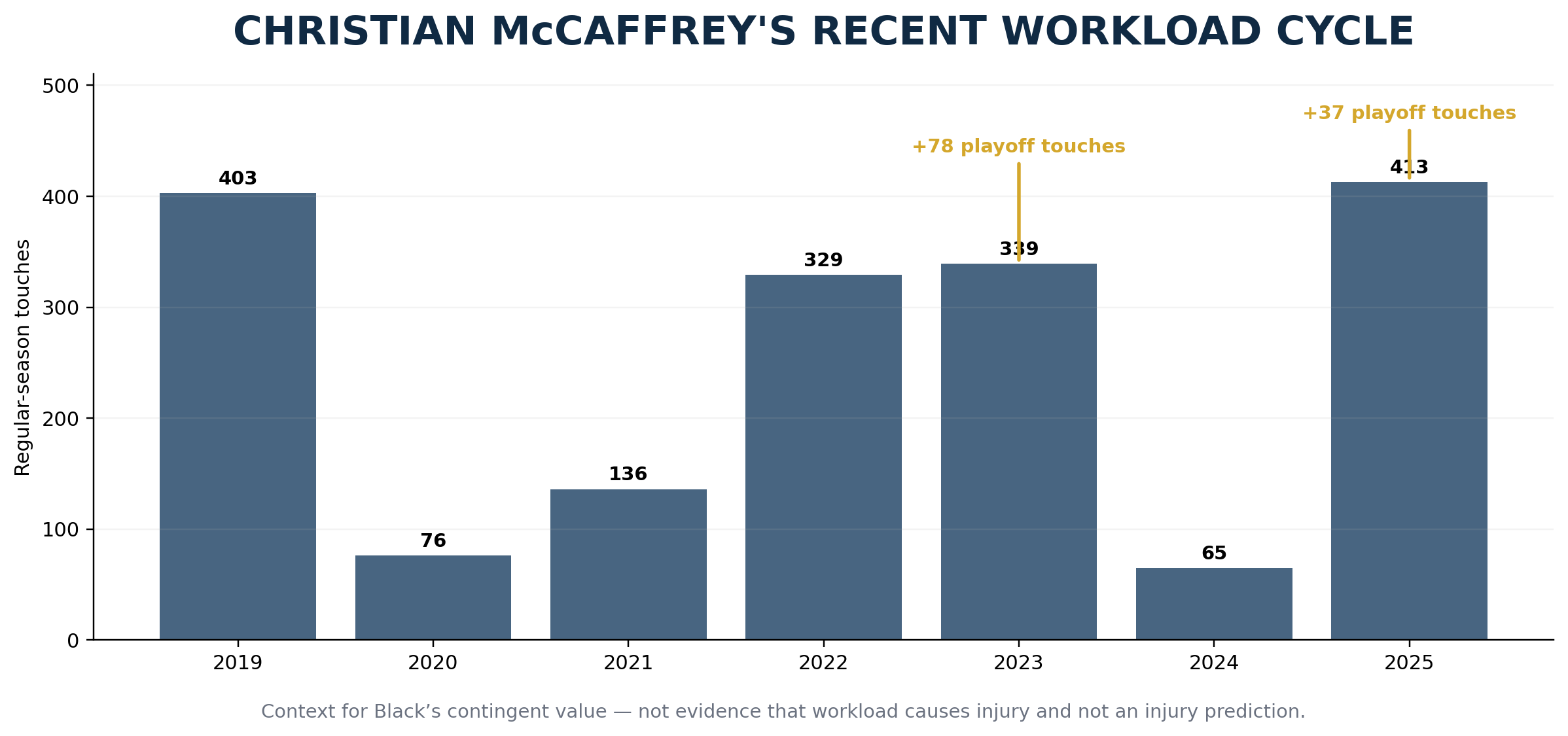
McCaffrey's workload history is context for Black's contingent value, not an injury prediction. The appeal is that Black has two paths: usable standalone rushing work if San Francisco really intends to lighten McCaffrey's load, plus enormous contingent value if the backfield ever opens completely.
PRESCRIPTION: PRIORITY — No. 3 waiver claim. PARTIAL is the diagnosis; PRIORITY is the action.
THE TOUGHEST CUT: Caleb Douglas, WR, Dolphins — ROLE VERDICT: REAL
Douglas came extremely close to the trigger we wrote down last week for vaulting him over Malik Washington: four catches, 90 yards, a touchdown and starter-level participation. He gave us the starter role, five catches and 94 yards — but no touchdown. So, first, he did not literally clear the pre-registered trigger. More importantly, that trigger was designed to answer a specific preseason question: did Douglas play enough, and produce enough, to show that he had become a real starter-level threat to Washington? The answer is yes. What it could not anticipate was Washington answering with an even stronger workload of his own.
Washington played more snaps. Washington ran more routes. Washington earned more targets. Washington had the higher target share. And both Miami receivers were targeted on the same 23% of their routes. Douglas rose exactly the way we hoped he might; Washington rose more. That's new Week 1 evidence, not a rewrite of the preseason rule.
That does not make Douglas a bad add. A third-round rookie playing 90% of the snaps, running 31 routes and earning seven targets in his debut is REAL role evidence. There is also encouraging evidence that Miami wants to feature him. If this were a four-player board, Douglas would be on it.
But we're forcing ourselves to recommend three. The choice between the two Miami receivers is the cleanest test of our premise in the entire article. The pre-registered Douglas trigger told us what would make him a legitimate challenger; it did not promise that Washington's own Week 1 evidence would stand still. Douglas won the box score. Washington won the workload. If we're serious about chasing the change rather than the points, Washington gets the spot.
PRESCRIPTION: FIRST PLAYER OUT. Douglas is a strong add if one of our top three is unavailable, and he may ultimately prove to have the higher ceiling. We just do not have enough workload evidence yet to rank him ahead of Washington.
What the Framework Actually Says
The market prediction remains Vele → Douglas → Black. Our recommendation board is Washington → Vele → Black. One player disappears; one player enters. That disagreement is not something to smooth over — it is the result of applying a workload-first framework instead of sorting Week 1 box scores.
| Player | Market | Role | Opening | Key evidence | Action |
|---|---|---|---|---|---|
| Malik Washington | Outside top 3 | REAL | Secure, organic | 98% snaps; 97% routes; 29.6% tgt share | PRIORITY — No. 1 |
| Devaughn Vele | No. 1 | REAL | Secure multiweek | 91% snaps; 81% routes; 9 targets | PRIORITY — No. 2 |
| Kaelon Black | No. 3 | PARTIAL | Potentially sustainable | 43.1% snaps; 14 carries; clear No. 2 | PRIORITY — No. 3 |
| Caleb Douglas | No. 2 | REAL | Secure, organic | 90% snaps; 86% routes; 25.9% tgt share | FIRST OUT |
The Tempting Alternatives
The New England opening remains worth attacking. A.J. Brown is on injured reserve with a high-ankle sprain and must miss at least four games. Mack Hollins is the strongest immediate candidate after leading Patriots wide receivers in Week 1 snaps and receiving yards; Kyle Williams is the higher-variance stash, but he played only 12 snaps and was not targeted in the opener. The opening is real. The owner is not yet clear.
Michael Mayer has real immediate opportunity if Brock Bowers stays sidelined, but that opening could vanish the moment Bowers returns. That's exactly the durability problem Step 2 is built to catch. Check the injury report before bidding.
Rashod Bateman is an opening-by-attrition play. Zay Flowers' Week 2 availability is the key variable, while Ja'Kobi Lane's absence appears more likely to persist. If Flowers also sits, Bateman's role grows against the Saints. Real if the injuries hold; speculative if they don't.
Tyler Allgeier remains worth rostering, but Week 1 didn't give us enough evidence that the underlying backfield hierarchy has materially changed.
Caleb Douglas is not listed here because he's already our first player out. If Washington, Vele or Black is unavailable in your league, Douglas is the next claim.
Freeze It
Now the part that matters: we write it down. No changing the rankings Wednesday morning because another waiver article comes out. No moving somebody up next week and pretending we liked him more than we did. No hindsight.
WEEK 2 MARKET PREDICTION
1. Devaughn Vele
2. Caleb Douglas
3. Kaelon Black
WEEK 2 WAIVER BOARD
1. Malik Washington — REAL → PRIORITY
2. Devaughn Vele — REAL → PRIORITY
3. Kaelon Black — PARTIAL → PRIORITY
FIRST PLAYER OUT
Caleb Douglas — REAL → strong add, but Washington wins the workload tiebreak.
Next week, we grade both. First: Did we understand the market — did Vele, Douglas and Black become the three eligible players fantasy managers chased most aggressively, and did we get the order right? Then the question that matters more: Did we understand the opportunity? Did Washington's near-every-down role hold? Did Vele's WR2 role survive a normal-volume game? Did Black's standalone workload persist?
The historical framework was built with the answers already sitting in front of us. We admitted that problem last week. This time we don't have them.
That's what makes Week 2 the first real test.
Don't chase the points. Chase the change.


2 thoughts on “Week 2 Waiver Wire: Who Everyone Will Add — and Who They Should”