We Froze the Board. The Waiver Wire Gave Us an Answer.
Last week, we tried to predict the Week 1 waiver frenzy before a snap was played. Tuesday, we froze a new market board and separately made our actual waiver recommendations. Wednesday gives us the first receipts.
The point of this series is simple: write down the calls before we know the answers, then grade the calls we actually made. No reranking after the fact. No replacing a frozen prediction with a looser version that happens to fit the result.
THREE BOARDS. THREE QUESTIONS.
SEPTEMBER 8 — THE BLIND MARKET PREDICTION
Question: Before Week 1, who did the Waiver-Frenzy Score predict the market would chase?
| Rank | Player | Waiver-Frenzy Score |
|---|---|---|
| 1 | Dontayvion Wicks | 88.2 |
| 2 | George Holani | 85.2 |
| 3 | Malik Washington | 81.4 |
Those were the official top-three predictions. We also froze player-specific Role Verdict triggers before kickoff so the football itself could be graded without hindsight.
SEPTEMBER 15 — THE FROZEN MARKET BOARD
Question: After seeing Week 1, which eligible players did we predict would be added most aggressively?
| Predicted Market Rank | Player |
|---|---|
| 1 | Devaughn Vele |
| 2 | Caleb Douglas |
| 3 | Kaelon Black |
This is the board that must be graded in order. We also made an additional directional call inside the Miami analysis: Douglas would be added more heavily than Malik Washington.
SEPTEMBER 15 — OUR ACTUAL RECOMMENDATIONS
Question: Which players did we think fantasy managers should add?
| Rank | Player | Role Verdict | Prescription |
|---|---|---|---|
| 1 | Malik Washington | REAL | PRIORITY |
| 2 | Devaughn Vele | REAL | PRIORITY |
| 3 | Kaelon Black | PARTIAL | PRIORITY |
That distinction matters. The market board predicts behavior. The recommendation board gives advice. We can grade the first on Wednesday morning. The second has to wait for Week 2 football.
EXPERIMENT NO. 1: THE SEPTEMBER 8 BOARD
The first out-of-sample Waiver-Frenzy Score missed its stated objective. Wicks, Holani and Washington did not become the three defining eligible post-Week-1 waiver adds. Caleb Douglas, who ranked fifth on the frozen board, generated much more market interest than any of the official top three.
But because we froze the Role Verdict triggers too, the three misses are not interchangeable.
THE FROZEN ROLE TEST
| Player | Frozen Trigger | Verified Week 1 Usage | Verdict |
|---|---|---|---|
| Wicks | REAL required 75%+ participation and 7+ targets; splash production on 4 or fewer targets = MIRAGE | 48 of 53 offensive snaps (91%); 26 routes; 4 targets; 2-73-1 | MIRAGE |
| Holani | REAL required leading Seattle RBs in snaps + 12 touches; 35–50% snaps and 8–12 touches in committee = PARTIAL | 23 snaps (46%); 8 carries for 29; 1 target, 0 catches | PARTIAL |
| Washington | REAL required 75%+ participation and 7+ targets | 49 of 50 snaps (98%); 35 routes on 36 dropbacks (97%); 8 targets | REAL |
No. 1 Dontayvion Wicks: The Exact Trap We Said We Wouldn’t Chase
Wicks’ first Eagles reception went for 64 yards, and he later caught a nine-yard touchdown. The verified final line was two catches for 73 yards and a touchdown on four targets. He played 48 of Philadelphia’s 53 offensive snaps (91%) and ran 26 routes. He also drew 85 air yards, 38.1% of the team’s air yards.
Those participation numbers are encouraging. They still do not satisfy the rule we wrote before kickoff. REAL required at least seven targets. We explicitly said a splash fantasy performance on four or fewer targets would trigger MIRAGE. Wicks received exactly four.
ESPN rostership moved from 10.1% to 16.9%, a 6.8-percentage-point increase: noticeable, but nowhere near the frenzy we predicted.
9/8 MARKET PREDICTION: MISS. FROZEN ROLE VERDICT: MIRAGE.
No. 2 George Holani: The Role Appeared. The Urgency Didn’t.
Seattle’s backfield really did reveal a meaningful Holani role. Jadarian Price played 24 offensive snaps; Holani played 23. Price carried 10 times for 52 yards and caught both of his targets for six yards. Holani carried eight times for 29 yards, drew one target and did not catch it.
That lands almost exactly in the PARTIAL bucket we defined beforehand: roughly 35–50% of the snaps and eight to 12 touches while Price maintained a major role.
Price was already heavily rostered entering the waiver cycle, so the market was not choosing between adding Price and adding Holani. The actionable question was whether Holani’s newly revealed 46% snap share was valuable enough to create urgency. The market largely decided it wasn’t.
The role appeared. The urgency didn’t.
9/8 MARKET PREDICTION: MISS. FROZEN ROLE VERDICT: PARTIAL.
No. 3 Malik Washington: The Market Prediction Missed. The Role Trigger Hit.
Washington cleared the REAL trigger cleanly. RotoWire charted him for 49 of Miami’s 50 offensive snaps (98%), 35 routes on 36 dropbacks (97%), eight targets, a 29.6% target share and 128 air yards. He finished with three catches for 53 yards.
Caleb Douglas also had a real role, but the exact verified numbers are slightly lower: 45 of 50 snaps (90%), 31 routes on 36 dropbacks (86%), seven targets, a 25.9% target share and 117 air yards. Douglas converted that opportunity into five catches for 94 yards.
So managers were not choosing a pure box-score mirage over the only player with a real role. They were choosing between two heavily involved Miami receivers, and Douglas produced the much louder Week 1 line.
9/8 MARKET PREDICTION: MISS. FROZEN ROLE VERDICT: REAL.
No. 4 Malik Davis: The Experiment Never Happened
Davis finished fourth on our frozen Waiver-Frenzy Score at 77.6.
But unlike the other players on this board, he never got a chance to test the model.
Davis suffered a serious hip injury in practice before Dallas played its Week 1 game. He underwent surgery the following day and was placed on season-ending injured reserve.
That matters for the receipts.
Our prediction was about what Week 1 could reveal — whether a player’s role, opportunity and performance would create a post-Week-1 waiver frenzy. Davis never played, so there was no Week 1 role to evaluate and no fair market reaction to grade.
Calling that a miss would be just as misleading as calling it a hit.
9/8 MARKET PREDICTION: VOID — SEASON-ENDING INJURY BEFORE WEEK 1.
No. 5 Caleb Douglas: Close Isn’t a Hit
Douglas finished fifth on the September 8 Waiver-Frenzy Score, not in the official top three. The model identified the right neighborhood and even identified Washington’s closest direct alternative, but the frozen ranking still missed. Douglas becoming a major add is a near miss, not a retroactive hit.
EXPERIMENT NO. 2: THE SEPTEMBER 15 MARKET BOARD
By Tuesday, we had Week 1 information. The formal market board was frozen as Vele first, Douglas second and Black third. That exact order is what Wednesday has to grade.
WHAT THE MARKET ACTUALLY DID
ESPN’s Most Added page gives us the cleanest apples-to-apples measurement because it reports seven-day change in rostership percentage. Among the eligible players on our frozen board, the actual order was Vele first, Black second and Douglas third.
| Actual Eligible Rank | Player | ESPN Before | ESPN Current | Change |
|---|---|---|---|---|
| 1 | Devaughn Vele | 12.9% | 37.2% | +24.3 pts |
| 2 | Kaelon Black | 15.4% | 37.4% | +22.0 pts |
| 3 | Caleb Douglas | 15.5% | 27.0% | +11.5 pts |
Jalen Coker had the largest overall increase in the captured ESPN view, rising from 50.8% to 75.7% (+24.9 points), but he began above our under-50% eligibility line on ESPN. He belongs in the broader market context, not on the eligible board.
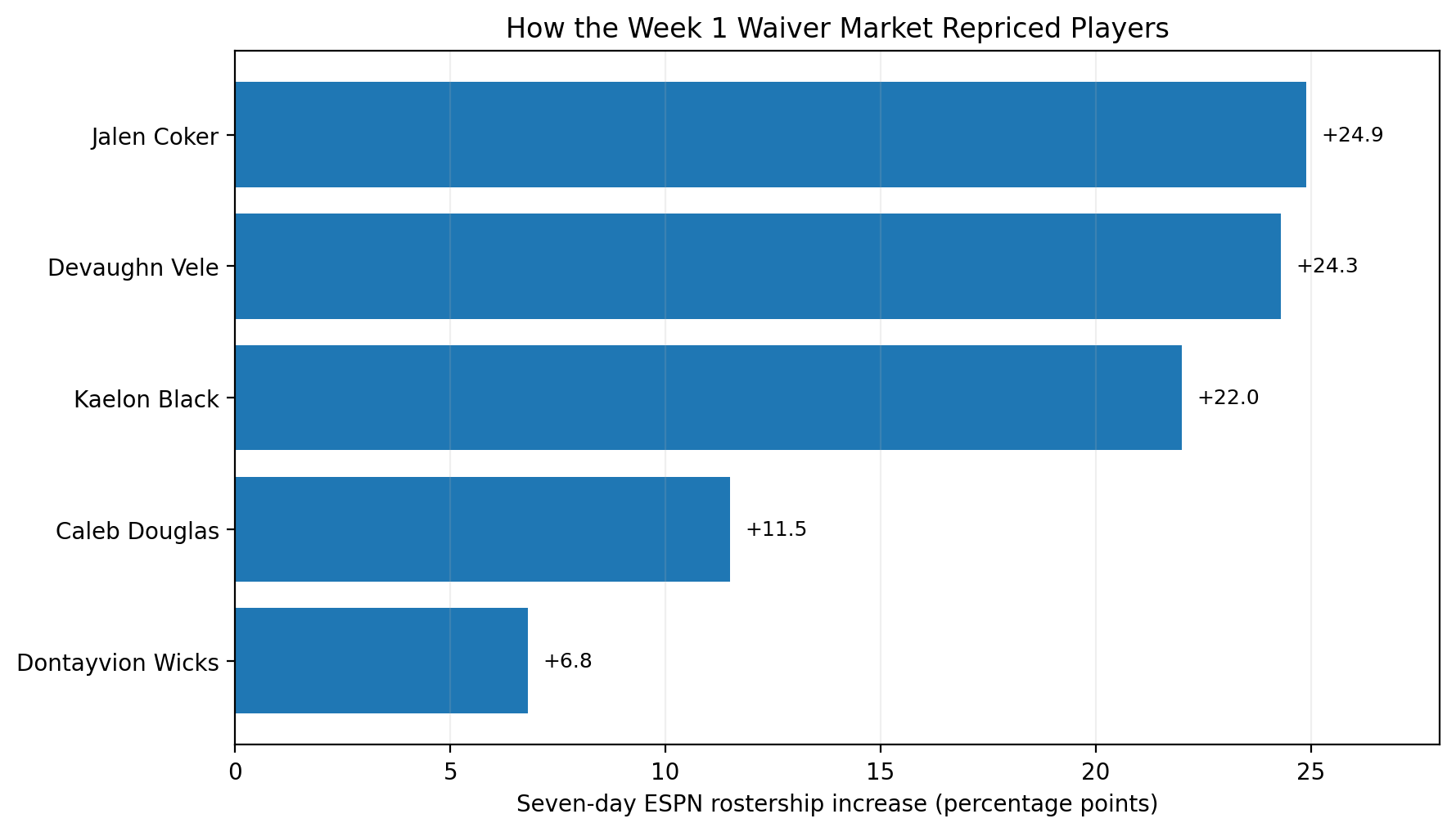
Figure 1. Seven-day ESPN rostership increase. Coker is shown for broader market context but began above the under-50% eligibility line.
THE RECEIPT: TOP THREE SET RIGHT. EXACT ORDER WRONG.
| Frozen 9/15 Prediction | Actual Eligible Order | Result |
|---|---|---|
| 1. Vele | 1. Vele | Correct |
| 2. Douglas | 2. Black | Order miss |
| 3. Black | 3. Douglas | Order miss |
The honest grade is not 3-for-3. We identified the correct three-player set, but we missed the exact order because Black and Douglas flipped. Vele finished where we predicted; Black drew more market movement than Douglas.
FROZEN BOARD VERDICT: TOP THREE SET NAILED; EXACT ORDER MISSED.
Separate directional call: Douglas would be added more heavily than Malik Washington. That call was correct. Washington did not appear in ESPN’s displayed Top 25 Most Added, while Douglas rose 11.5 percentage points.
WASHINGTON VS. DOUGLAS: WE PREDICTED THE MARKET — THEN BET AGAINST IT
This remains the cleanest test of our process. Tuesday’s market board put Douglas ahead of Washington, and the article explicitly expected Douglas’ 5-94 line to attract more managers than Washington’s quieter 3-53.
Then the recommendation board did the opposite: Washington was our No. 1 add, while Douglas was outside the top three recommendations.
Why? The verified usage favored Washington by a small but real margin: 98% snaps versus 90%, 97% route participation versus 86%, eight targets versus seven, 29.6% target share versus 25.9%, and 128 air yards versus 117. Douglas won the Week 1 production battle by a lot. Washington won the underlying opportunity comparison by a little.
The market prediction has now been graded. The recommendation has not.
9/15 DIRECTIONAL MARKET CALL: CORRECT — Douglas over Washington. 9/15 RECOMMENDATION: Washington No. 1 — PENDING.
VELE: THE MARKET BOARD GOT NO. 1 RIGHT
Vele’s verified Week 1 box score was seven catches on nine targets for 69 yards and a touchdown. He played 82 of New Orleans’ 90 offensive snaps, a 91% snap share. The Saints threw 56 passes in an overtime game, which is exactly why Tuesday’s recommendation warned that the raw volume could cool.
Our frozen Tuesday thesis used a 91% snap share and 81% route rate and described Vele as a full-time WR2 with a multiweek runway. For this receipts piece, the key independently verified facts are the 82-of-90 snap count, nine targets and 7-69-1 receiving line.
The market agreed emphatically: ESPN rostership rose 24.3 percentage points, from 12.9% to 37.2%. Vele finished first among the three eligible players on our frozen board, exactly where we predicted him.
9/15 MARKET BOARD: Vele No. 1 — CORRECT. 9/15 RECOMMENDATION: Vele No. 2 — PENDING.
BLACK: THE PLAYER WE UNDERRANKED ON THE MARKET BOARD
Black’s Week 1 workload is also cleanly verified. He played 28 of San Francisco’s 65 offensive snaps (43.1%), carried 14 times for 65 yards and caught his only target for five yards. Christian McCaffrey played 36 snaps (55.4%) and had 10 carries; Black therefore won the rushing-attempt battle 14-10.
We correctly expected Black to draw major interest, but the frozen board placed him third behind Douglas. The market moved him from 15.4% rostered to 37.4%, a 22-point jump — enough to finish second among our three eligible predictions.
So this is where the formal ordering miss occurred. Black was not merely a directional hit; he was more aggressively repriced than Douglas, and our board had those two reversed.
9/15 MARKET BOARD: Black No. 3 — ACTUAL No. 2. ORDER MISS. 9/15 RECOMMENDATION: Black No. 3 — PENDING.
DOUGLAS: RIGHT PLAYER, WRONG SLOT
Douglas’ verified usage was 45 of 50 offensive snaps (90%), 31 routes on 36 Miami dropbacks (86%), seven targets, a 25.9% target share, 117 air yards and five catches for 94 yards.
That was enough to generate a significant market move: 15.5% to 27.0% on ESPN, up 11.5 percentage points. But Black moved more.
The September 15 market board had Douglas second. He finished third among the eligible trio. The player identification was right; the ordering was not.
9/15 MARKET BOARD: Douglas No. 2 — ACTUAL No. 3. ORDER MISS.
WHAT DID THE MARKET ACTUALLY REWARD?
| Player | Verified Week 1 Role / Usage | Production | Market Reaction |
|---|---|---|---|
| Wicks | 91% snaps; 26 routes; 4 targets | 2-73-1 | Modest |
| Holani | 46% snaps; 8 carries; 1 target | 29 rush yds | Limited |
| Washington | 98% snaps; 97% routes; 8 targets | 3-53 | Limited |
| Douglas | 90% snaps; 86% routes; 7 targets | 5-94 | Heavy |
| Vele | 91% snaps; 9 targets | 7-69-1 | Very heavy |
| Black | 43.1% snaps; 14 carries; 1 target | 70 scrimmage yds | Very heavy |
One week suggests a useful hypothesis: predicting an actual waiver frenzy may require more than identifying change. The biggest reactions came when newly revealed opportunity arrived with immediate proof in the box score.
Douglas had a major role and 94 yards. Vele had a full-time role and 7-69-1. Black had a surprising 14-carry role and 70 scrimmage yards. Washington had the strongest Miami participation profile but only 53 receiving yards. Holani revealed a committee role without strong efficiency. Wicks produced splash plays without the target volume our own trigger required.
Call it CHANGE + PROOF = FRENZY for now. One week is not enough to rewrite a 10-year model. It’s enough to write the hypothesis down and test it again.
THE SCOREBOARD
SEPTEMBER 8 — BLIND MARKET PREDICTION
| Frozen Prediction | Market Result | Frozen Role Verdict |
|---|---|---|
| 1. Wicks | MISS | MIRAGE |
| 2. Holani | MISS | PARTIAL |
| 3. Washington | MISS | REAL |
Official top-three market prediction: 0-for-3.
SEPTEMBER 15 — FROZEN MARKET BOARD
| Predicted | Actual Eligible Order | Grade |
|---|---|---|
| 1. Vele | 1. Vele | Correct |
| 2. Douglas | 3. Douglas | Order miss |
| 3. Black | 2. Black | Order miss |
Board grade: correct top-three set; exact order missed because Black and Douglas flipped. Additional directional call — Douglas over Washington — correct.
SEPTEMBER 15 — ACTUAL RECOMMENDATIONS
| Rank | Recommendation | Status |
|---|---|---|
| 1 | Malik Washington — REAL → PRIORITY | PENDING |
| 2 | Devaughn Vele — REAL → PRIORITY | PENDING |
| 3 | Kaelon Black — PARTIAL → PRIORITY | PENDING |
Recommendation record: not yet gradeable. Week 2 has not been played.
NOW WE GRADE THE FOOTBALL
Wednesday morning tells us whether we understood the waiver market. It does not tell us whether our waiver advice was good. Popularity is not correctness.
Next Wednesday’s Report Card grades the role and opportunity thesis we actually bought. Washington is about whether the near-every-down participation and target demand persist. Vele is about whether the full-time role survives when New Orleans’ extreme Week 1 volume normalizes. Black is about whether the standalone rushing role survives a different game environment with a healthy McCaffrey.
Those calls are frozen. They will receive one of four grades: CONFIRMED, TOO EARLY, FADING or BUSTED. TOO EARLY can only be used once.
No changing the criteria after the game. No turning a touchdown on a handful of touches into proof of a great process. No calling eight targets meaningless because they didn’t immediately become fantasy points. No moving the goalposts.
The September 8 experiment told us we did not predict the first waiver frenzy well. The September 15 market board did much better at identifying the right three names, but it still missed the exact order. The recommendation board is the next test.
Now they have to play.
DATA & VERIFICATION NOTE
All Week 1 usage figures in this revision were rechecked against current snap-count, route, target and game-log sources before publication. Where public sources differ slightly because of stat-provider methodology, this article uses one internally consistent source for each usage comparison rather than mixing denominators.
For Miami, the standardized figures are: Malik Washington — 49 of 50 snaps (98%), 35 routes on 36 dropbacks (97%), eight targets, 29.6% target share, 128 air yards; Caleb Douglas — 45 of 50 snaps (90%), 31 routes on 36 dropbacks (86%), seven targets, 25.9% target share, 117 air yards.
For Philadelphia, Wicks is standardized at 48 of 53 offensive snaps (91%), 26 routes and four targets. For San Francisco, Black is standardized at 28 of 65 snaps (43.1%), 14 carries for 65 yards and one catch for five yards. For New Orleans, Vele is standardized at 82 of 90 snaps (91%) with nine targets, seven catches, 69 yards and one touchdown. For Seattle, Holani is standardized at 23 snaps, eight carries for 29 yards and one target; Price played 24 snaps, carried 10 times for 52 yards and caught two passes for six yards.
The market chart uses ESPN’s seven-day rostership movement because it provides a consistent denominator. Yahoo and Sleeper transaction counts can corroborate direction and ordering, but raw add totals from different platforms should not be compared as though they measure the same thing.


One thought on “We Froze the Board. The Waiver Wire Gave Us an Answer.”