There are few feelings in life better than finding out you have the first pick in your fantasy football draft. Maybe the birth of a child. Maybe watching the Berlin Wall crumble. Maybe walking into 11 and A Boogie Wit Da Hoodie daps you up and brings you on stage to rap “My Shit” with him. I don’t know. But 1.01 is up there.
You open the draft order and there it is: first. Eleven other people have to sit there helplessly while you get your pick of every football player in America. No ADP concerns. No contingency plans. No praying some moron takes Josh Allen fourth. The entire player pool is yours. You are Roger Goodell walking to the podium. You are Julius Caesar crossing the Rubicon. You are me throwing millions in the air at my table at 11 with A Boogie Wit Da Hoodie.
Congratulations. Historically, this has been a death sentence. Or has it?
I have the first pick this year in two leagues, which is what sent me down this rabbit hole in the first place. I’m taking Jahmyr Gibbs. I’ve accepted this. I love Jahmyr Gibbs. I would let Jahmyr Gibbs perform open-heart surgery on me. So naturally, immediately before I have to draft him, I decided to investigate whether having the first pick in a fantasy football draft is actually good.
This was a mistake.
An Investigation
I started with a pretty simple question: What actually happens to the guy everybody thinks should go first? Then, like all good investigations, it got completely out of control.
I went back through 26 years of fantasy football, from 2000 through 2025. I started with 2018. I consider “modern fantasy football” as beginning in 2018. I don’t really know why. I guess that was my first year playing as an adult, or at least a college graduate with a job. I then realized fantasy football and the internet has been around for way longer so it would be more scientifically accurate to expand my search.
For every season, I took the preseason consensus No. 1 player and compared him against every running back, wide receiver and tight end in full-PPR scoring. Not positional ranking. Overall. If we’re calling somebody the No. 1 overall fantasy football player, then I’m grading him against everybody. Aside from quarterbacks. That would break this research as preseason rankings would never have a QB ranked first overall for a standard PPR non superflex league. Unless you write for IDKBall.net.
Then I flipped the study around. Who actually finished as the highest-scoring non-quarterback that season? And where the hell did we have that guy ranked before the season?
Here’s the crime scene.
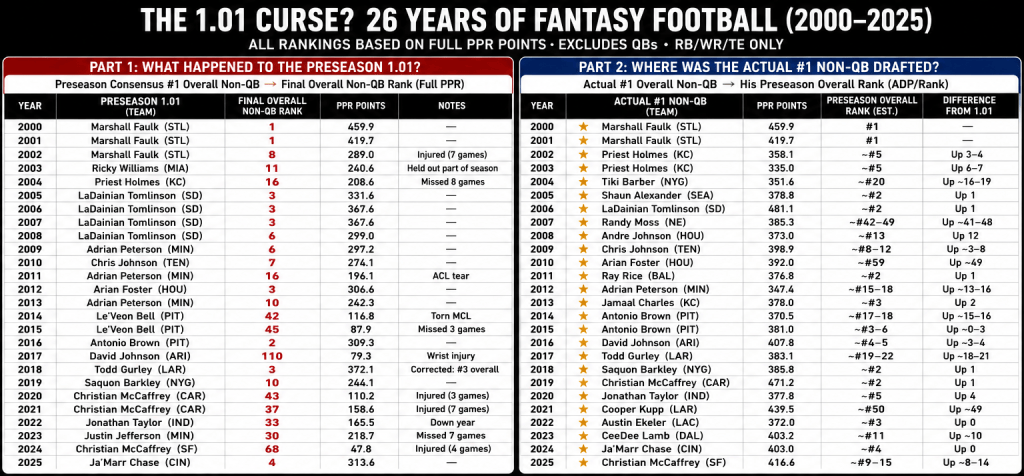
Some of the older seasons require a little archeology. There was no Sleeper app in 2002. Fantasy football information was presumably exchanged on message boards by men named BigDog69 as their moms yelled at them for needing the phone line back. That’s a dial-up internet joke for you nerds.
There are also a few seasons where there wasn’t one universally agreed upon No. 1, which is the nature of trying to reconstruct fantasy drafts conducted during the Bush administration.
But the larger finding isn’t particularly subtle.
Marshall Faulk Was Apparently the Last Honest Man in America
In 2000, Marshall Faulk was the No. 1 player in fantasy drafts and finished as the highest-scoring non-QB. In 2001, Marshall Faulk was once again the No. 1 player in fantasy drafts and once again finished as the highest-scoring non-QB.
Great. System works.
It hasn’t happened since.
The last preseason 1.01 to actually finish the season as fantasy football’s highest-scoring non-quarterback was Marshall Faulk in 2001. I was five. Shrek was in theaters. George W. Bush had been president for eight months. The first iPod hadn’t been released yet. Tom Brady entered that season with three career NFL passes. Back in my day we had Johnny Cash, Bob Hope and George Bush. Now we have no cash, no hope and no bush.
This was apparently the last time humanity successfully identified the best fantasy football player before a season. Then we lost the technology.
How Bad Is It?
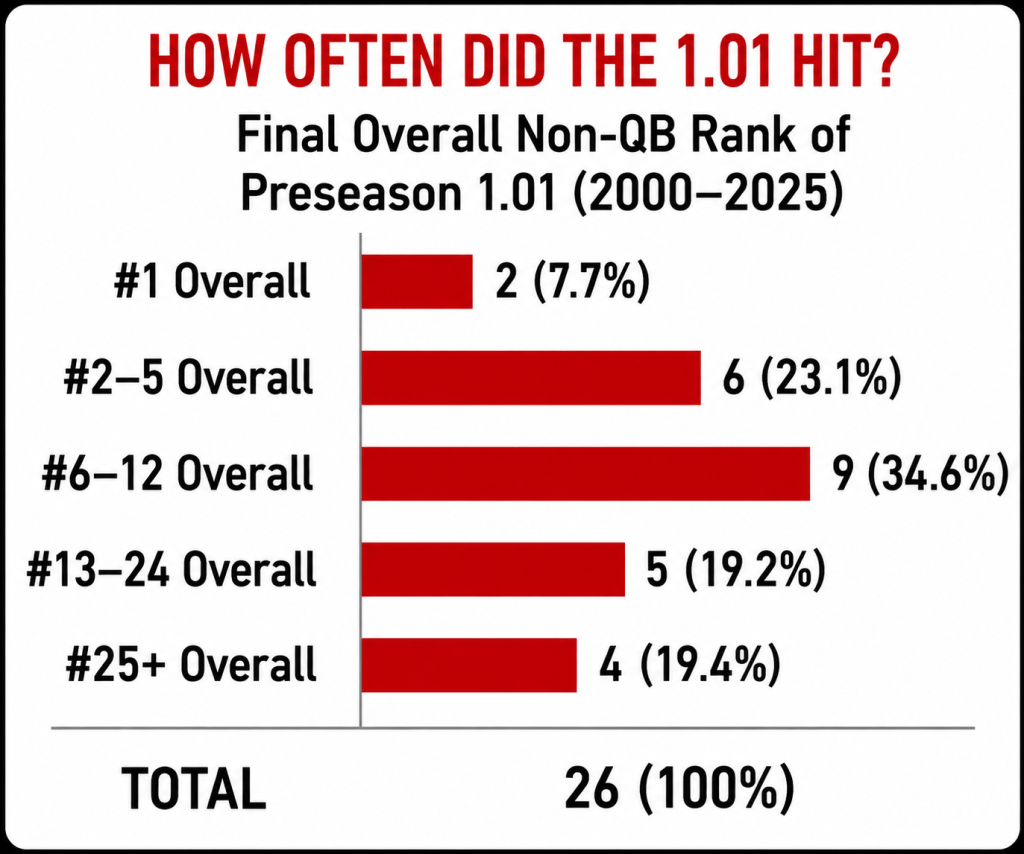
The preseason No. 1 has actually finished as the No. 1 non-QB twice in 26 seasons, and both were Marshall Faulk. Only eight of the 26 even finished inside the top five. Nine finished outside the top 24.
Think about that for a second. You’re handed the first selection of every football player on Earth and more than a third of the time, historically, that player hasn’t even finished among the 24 highest-scoring running backs, receivers and tight ends. Imagine winning the lottery and using the money to buy a timeshare.
And the individual disasters are incredible. Le’Veon Bell. David Johnson. Christian McCaffrey. Christian McCaffrey again. Jonathan Taylor. Justin Jefferson. Christian McCaffrey again, because apparently we enjoy learning lessons several times.
McCaffrey might actually deserve his own investigation. He went first in 2020 and the season was a disaster. We came back and drafted him first again in 2021. Another disaster. Then, after several years had passed and the memories faded, we got the gang back together in 2024 and did it again.
Four games.
The United States invaded Iraq once and people are still arguing about it. We drafted Christian McCaffrey first overall three different times and got burnt three times. Is he like Saddam? Keep him away from Kuwait PLEASE.
The funny part is that the logic was perfectly defensible every time. That’s the entire problem. We’re not trying to identify whether Christian McCaffrey is good at football. I have completed that investigation and can confirm he is. We’re trying to identify which elite football player will remain healthy, maintain his role, survive 17 games, avoid having his offense implode, score an unreasonable number of touchdowns and outperform every other elite player at three different positions.
Four months in advance.
Seems reasonable.
Where the Fuck Is the Right Guy?
Somebody has to finish first, which is where the other side of this gets much more interesting.
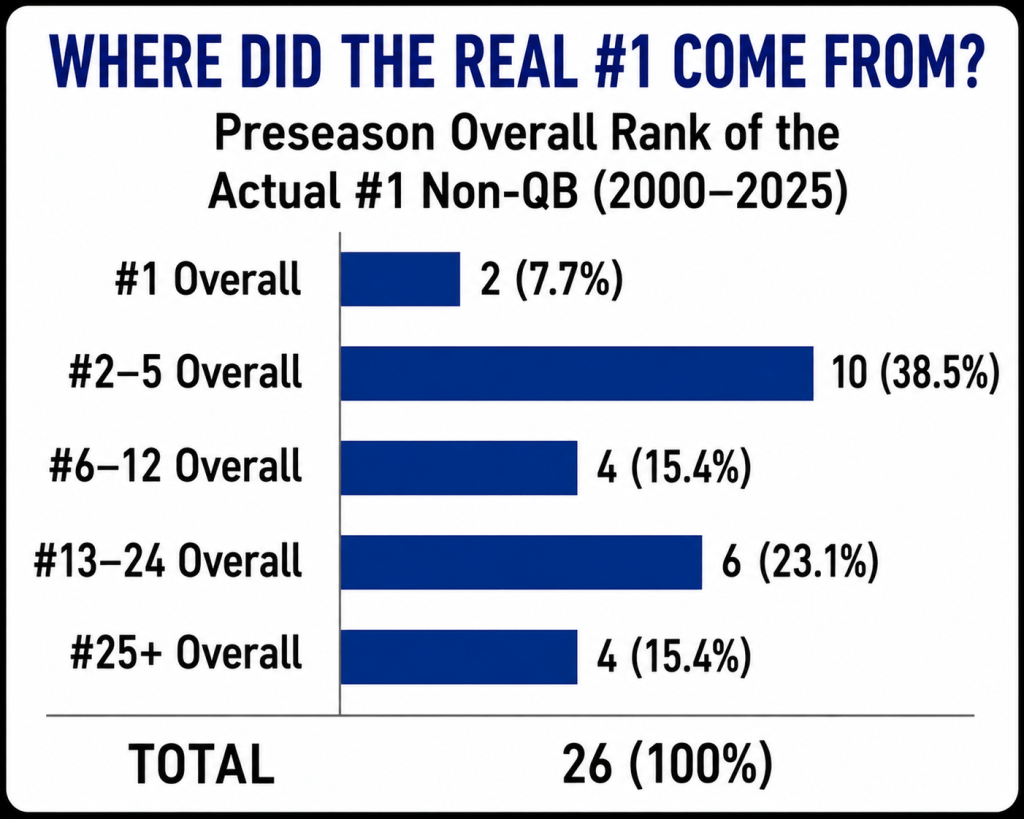
Sometimes we basically got it right. The eventual No. 1 was sitting second or third in the preseason rankings. That’s not some catastrophic failure by fantasy analysts. That’s basically getting the answer right and bubbling the wrong circle on the Scantron.
Then there are the other years, and those are fucking hilarious.
Tiki Barber around 20th. Randy Moss somewhere in the 40s. Arian Foster around 59th. Todd Gurley around 20th. Cooper Kupp around 50th.
Think about Kupp for a second. We spent the summer of 2021 debating Christian McCaffrey, Dalvin Cook, Alvin Kamara, Derrick Henry, Ezekiel Elliott and whoever else. The correct answer was Cooper Kupp. He was sitting around 50th overall. You could have drafted four other people and then selected the best player in fantasy football.
That’s not drafting. That’s finding a winning scratch-off ticket on the floor of a 7-Eleven.
But Maybe None of This Matters
This is where my investigation should have ended. It did not, because there’s an obvious objection to everything I just wrote: Who gives a shit if the 1.01 actually finishes first?
Fantasy football isn’t a season-long points competition. We’re trying to win championships. If I draft Jahmyr Gibbs first and he finishes sixth but I win the league, I’m not going to spend January demanding an apology. You know where I’ll be and who I’ll be with. It rhymes with seven and Bay Noogie wit da Goodie.
Maybe Marshall Faulk being the last preseason No. 1 to actually finish No. 1 doesn’t matter. Maybe simply drafting from the first slot gives you an advantage. You get whichever player you want, and then in a 12-team snake you get Picks 24 and 25 coming back. Maybe that roster construction advantage is valuable even if the player you take first doesn’t literally finish first.
So I went looking for a different set of data: where do championship teams actually draft from?
This turned out to be significantly harder to research. Apparently ESPN does not maintain a public 25-year database titled Where Did The Idiots Who Won Their League Draft From? which feels like a missed opportunity.
But Sleeper has actually looked at this.
In 2018, The First Pick Was Awesome
Sleeper published its 2018 results ranking draft positions by winning percentage. In 10-team leagues, the order from best to worst was:
1, 5, 7, 6, 4, 8, 3, 9, 2, 10.
In 12-team leagues:
1, 5, 6, 7, 11, 10, 9, 12, 4, 8, 3, 2.
So there you have it. Pick 1 was the best spot in both formats.
After spending several thousand words constructing a federal case against the first overall pick, I have discovered evidence that completely undermines my own article.
This is journalism.
But look at the rest of the order, because that’s actually more interesting. Pick 5 was second-best in both formats. In 12-team leagues, Pick 2 was dead last, while Picks 11 and 10 finished fifth and sixth. Sleeper published the ordering rather than the underlying percentages, so I’m not going to invent a difference between first and second that we don’t actually know. But we can say pretty confidently that this wasn’t simply a neat progression where earlier pick equals better outcome.
According to the previously placed chart, Todd Gurley was the consensus number one overall pick in 2018. He finished as the 3rd highest scoring non QB player. However, he missed week 16, also known as the fantasy championship unless your league sucks (he missed week 17 too if your league does indeed suck). I knew this without looking it up because I won the championship that year and I faced a guy who had Todd Gurley.
Gurley very well could have finished number one overall if he played week 16. Regardless, he was so good that he was a solid first overall pick and led many teams to the championship, even if he didn’t play in the championship itself. Once you’re there anything can happen.
And then I found 2023.
Five Years Later, Everything Flipped
The reported Sleeper championship results from 2023 look almost nothing like 2018.
For 10-team leagues, the ranking was:
2, 10, 3, 1, 9, 6, 4, 5, 8, 7.
Pick 2 produced the most champions. Pick 10 was second. Pick 1 was still perfectly respectable at fourth
Then we get to the 12-team leagues:
12, 11, 10, 2, 3, 9, 8, 6, 7, 5, 1, 4
Read the beginning of that again.
12. 11. 10.
The three draft positions that produced the most champions were the final three spots in the first round. Pick 12 was first. Pick 11 was second. Pick 10 was third.
Pick 1?
Eleventh out of twelve.
Justin Jefferson was the consensus 1.01 going into the season. He missed seven games due to a hamstring injury
Five years earlier, Sleeper had Pick 1 ranked first in 12-team leagues. Now it was second to last. Pick 12 went from eighth to first.
Apparently the optimal place to draft is wherever the good players happen to be.
Groundbreaking.
We Have Narrowed the Best Draft Position Down to Somewhere Between 1 and 12
This is where the idea that there must be one inherently superior draft position starts falling apart.
The mechanics didn’t change. In a 12-team snake, Pick 1 still gets 1, 24 and 25. Pick 12 gets 12, 13 and 36. Yet Sleeper’s results went from Pick 1 leading in 2018 to Pick 12 leading in 2023.
That suggests something much more obvious and much less satisfying: the value of your draft position depends heavily on which players are attached to those picks in that particular year.
The chair isn’t valuable. The opportunity the chair gives you is valuable.
And sometimes we badly misprice that opportunity.
There Is More Evidence, and Unfortunately It Is Also Bad for Me
Sleeper is the data I care about most here because it resembles the actual managed leagues most of us play. But I also wanted a larger sample, and that’s where FFPC’s Best Ball Slim data becomes useful as supporting evidence.
Important disclaimer before somebody screams at me: best ball is not redraft. There are no waiver moves or weekly lineup decisions, and FFPC has its own scoring rules. I am not taking a best-ball sample and pretending it proves what happens in your home standard redraft league.
But RotoViz analyzed six consecutive seasons of single-QB FFPC Best Ball Slim data from 2020 through 2025, and the results are pretty hard to ignore.
The No. 1 draft position significantly underperformed in every one of the six seasons. The aggregate historical win rate for the first slot was just 4.2%; even including the unusual teams that took a quarterback first only brought it to 5.7%.
Six seasons. Six underperformances.
Remember, I HAVE THE FIRST PICK.
I began this investigation because I wanted to feel better about Jahmyr Gibbs. Instead I appear to have discovered the fantasy football Zapruder film.
And it isn’t only the first pick. If you divide those six seasons into sections of the draft board, Picks 1–4 exceeded the expected 8.3% baseline in only 9 of 24 slot-seasons. Picks 5–8 did it 17 of 24 times. Picks 9–12 did it 15 of 24 times.
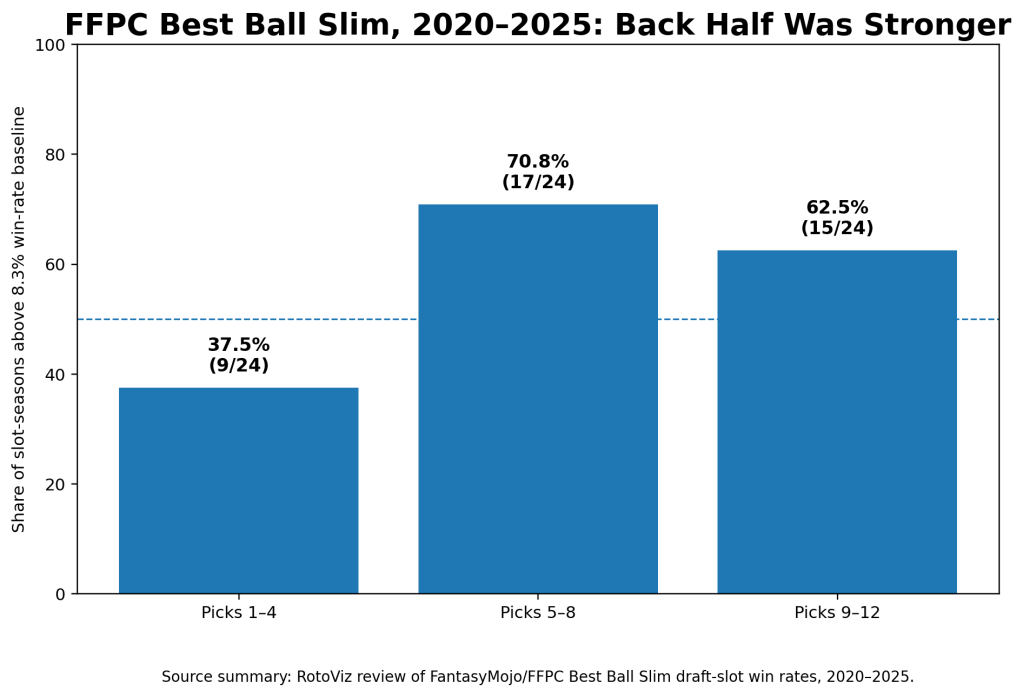
That’s 37.5% for the front four, 70.8% for the middle four and 62.5% for the final four.
Cut the board in half and the same pattern remains. Only 16 of 36 first-half slot-seasons cleared the baseline, compared with 24 of 36 from the back half — 44.4% versus 66.7%.
Again, best ball. Different game. Supporting evidence, not gospel.
But it is another fairly large flashing sign saying STOP ASSUMING THE FRONT OF THE DRAFT IS AUTOMATICALLY BETTER.
The Draft Slot Isn’t the Advantage. Being Right Is.
This is the part I think actually matters.
Fantasy players talk about draft position like it’s a permanent mathematical property. “I want Pick 3.” “Pick 7 sucks.” “I need to be near the turn.” People find out they’re drafting ninth and react like their village has been burned by the Mongols.
But Pick 9 doesn’t mean anything without knowing who Pick 9 buys you.
In one season, drafting first gets you Marshall Faulk. In another, it gets you Christian McCaffrey for four games. One year Pick 12 means you’ve missed every player you actually wanted. Another year Pick 12 puts you in exactly the right place to grab two players whose preseason prices were wrong.
The snake isn’t changing.
The players are.
And the FFPC data actually reinforces that interpretation. RotoViz found the individual draft-position results varied substantially from year to year and cautioned against reading too much into any one slot from only six seasons of observations.
Which brings us back to Sleeper.
Pick 1 was first in 2018.
Pick 12 was first in 2023.
That’s not contradictory evidence anymore. That’s the point.
The Two Investigations Are Actually the Same Investigation
This is where everything finally comes together.
The consensus 1.01 study tells us that we’re remarkably bad at identifying the single best fantasy player before a season. The draft-position study tells us that the consequences of those mistakes ripple through the entire first round.
If we nail the top of the player pool, drafting first can be fucking fantastic. Sleeper 2018 shows that.
If we badly misprice the top of the player pool, or there is a catastrophic injury, drafting first can become an anchor while somebody drafting 10th, 11th or 12th gets two players whose prices were much closer to reality. Sleeper 2023 shows that.
And that’s why the later-round league winners matter so much.
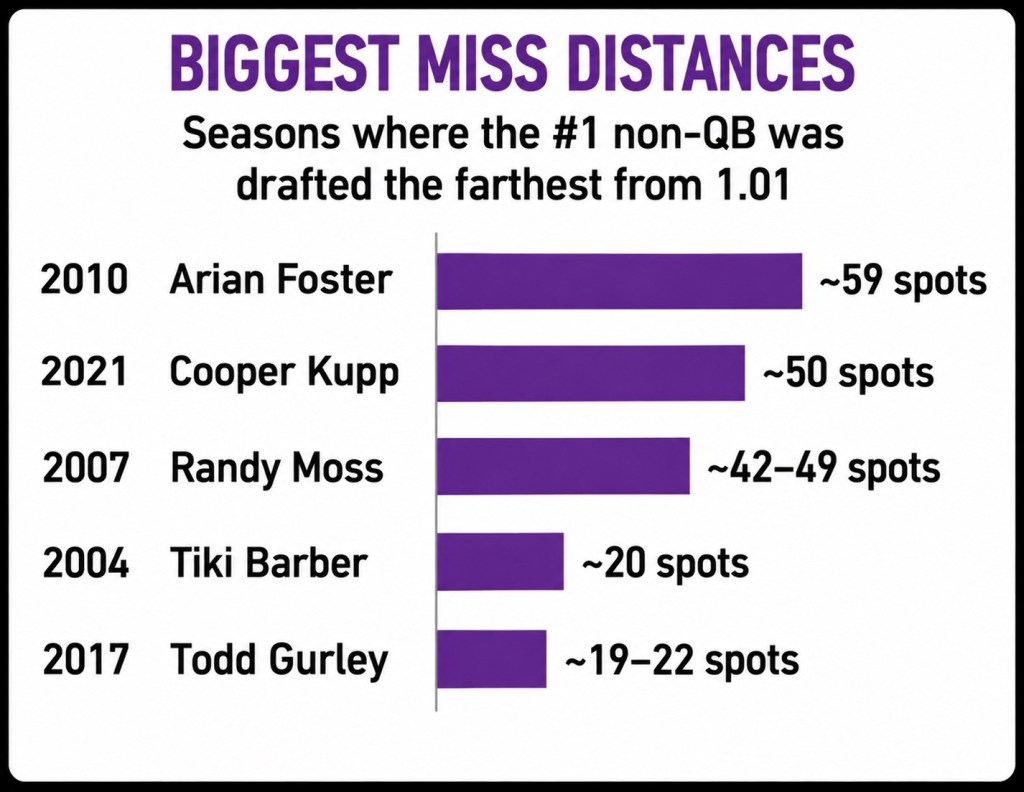
Arian Foster around 59th. Cooper Kupp around 50th. Randy Moss in the 40s.
Those aren’t merely good fantasy picks. Those picks break leagues, because the manager who drafted Cooper Kupp around 50th didn’t have to choose Cooper Kupp instead of Christian McCaffrey.
He got to draft four other players first.
That’s the actual cheat code.
Not Pick 1. Not Pick 7. Not Pick 12.
Drafting the player whose price is catastrophically wrong.
Which Brings Me Back to Jahmyr Gibbs
Fuck.
I really could have done without researching any of this.
I have the first pick. Jahmyr Gibbs is sitting there. I love the player. I love the situation. I love the upside. He is the guy I want.
The rankings agree.
Which, after everything you’ve just read, is apparently the worst fucking news imaginable.
Somewhere right now, the actual 2026 fantasy football king is sitting innocently on a draft board while millions of us scroll past him. Maybe he’s ranked fourth. Maybe he’s 18th. Maybe he’s 47th.
It could be De’zhaun Stribling or Bhayshul Tuten.
Jesus Christ.
I’m still taking Gibbs. What the fuck else am I supposed to do?
That’s the beautiful stupidity of all of this. We spend months gathering information. We rank hundreds of players. We study target shares, offensive lines, coaching changes, strength of schedule, red-zone usage, age curves and injury histories. We argue about whether we’d rather draft first, fifth or tenth. We convince ourselves we’ve solved it.
Then the draft starts. The clock says 1:30. You click a name.
And for the next four months you find out what God thinks of you.
Jahmyr Gibbs, come on down. Let’s hope it is 2001 again…. Well, maybe 2000.

