
Every September, 32 NFL head coaches report for work. All 32 have plans. They have laminated play sheets, leadership councils and culture. They spent the entire summer telling reporters that their third-year guard is “in the best shape of his life.”
Some of these men will be unemployed by Halloween.
This is not speculation. This is science.
I became interested in this for the same reason Thomas Edison became interested in electricity or Mark Zuckerberg became interested in making Facebook. I read other people’s work on the subject and figured I could do it better and ultimately get the credit for it.
I don’t want to know that Shane Steichen is “under pressure.” I am under pressure every time I open my credit card statement. Nobody is writing articles about it. I want a date. I want to know exactly when an NFL owner is going to wake up, look at the standings and decide another man’s family needs to start browsing Zillow.
So I went back ten years.
THE NFL IS EXTREMELY GOOD AT FIRING PEOPLE
Before we determine which NFL head coaches are about to lose their jobs, I wanted to establish something important: is the NFL actually unusually willing to fire a coach while the season is still happening?
Yes. Mostly.
Across the same ten-season window, Major League Baseball fired 14 managers during the regular season. The NBA fired 18 head coaches. The NFL fired 23.
And then there is hockey.
The NHL fired 40.
I guess that’s that stereotypical Canadian ruthlessness is true.
So no, the NFL is not the most trigger-happy major league. Hockey exists. But football comfortably clears baseball and basketball despite giving teams only 17 regular-season games to decide that the man they spent all summer describing as a “leader of men” is not Vince Lombardi.
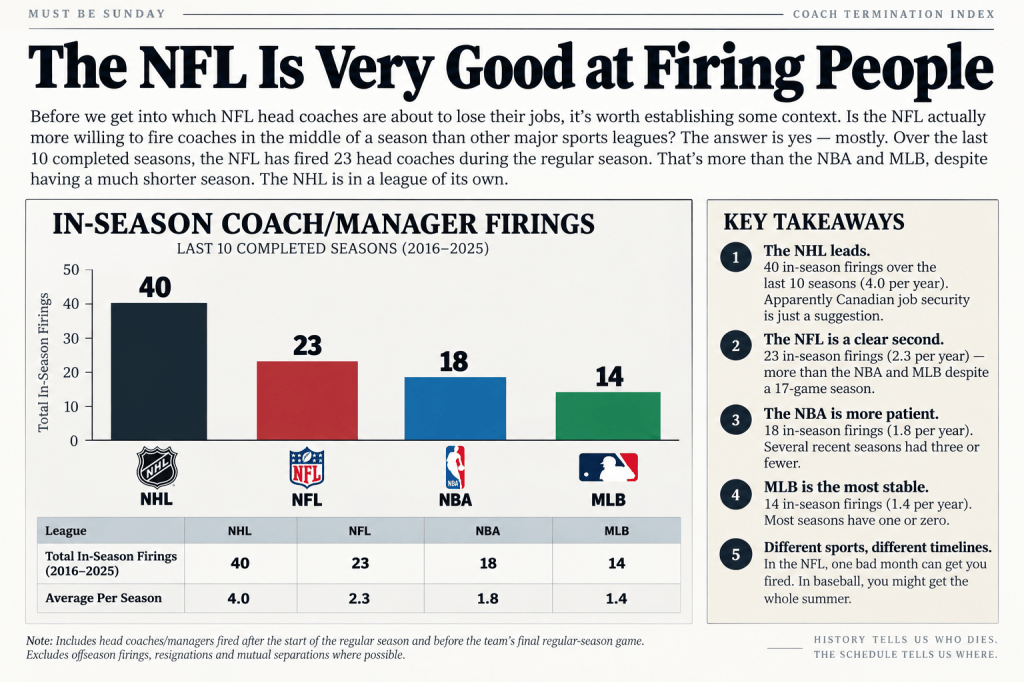
That is what makes the NFL number useful. Baseball has 162 games. Basketball and hockey have 82. Football gets 17. There is almost no time to slowly become disappointing. One ugly September can turn into an organizational crisis before anyone has put their Halloween decorations up.
And over the last ten NFL seasons, that crisis has ended the same way 23 times.
Now we can narrow the investigation from professional sports generally to the 32 men currently wearing quarter-zips on NFL sidelines.
For purposes of this investigation, an in-season firing means a head coach fired after the regular season begins but before his team’s final regular-season game. Resignations don’t count. Mutual separations don’t count. Black Monday doesn’t count. I want somebody who showed up to work during football season believing he was an NFL head coach and, sometime before the season ended, discovered he wasn’t.
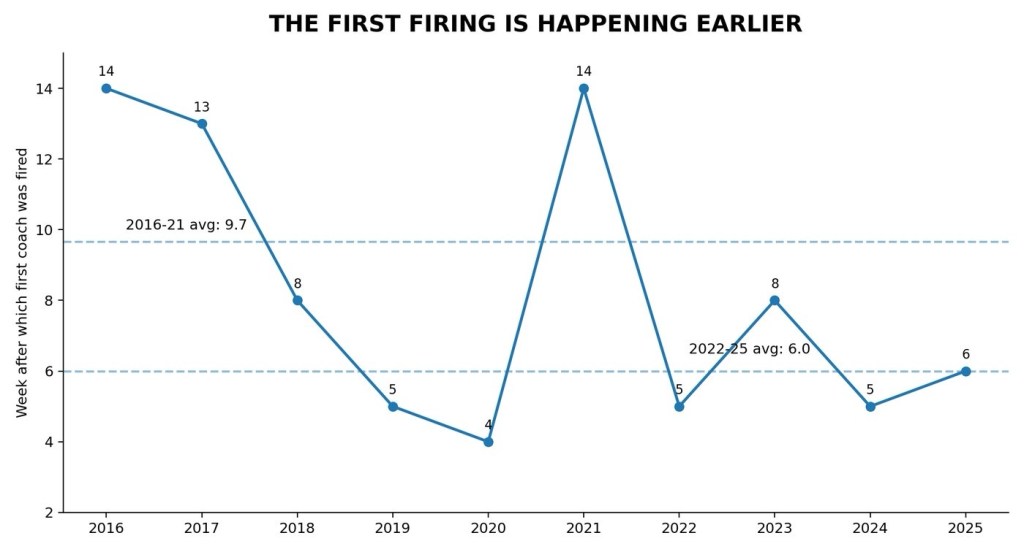
Using that definition, there were 23 in-season head-coaching firings from 2016 through 2025.
Twenty-three in ten years: 2.3 per season.
The Federal Reserve targets 2% inflation. The NFL targets 2.3 unemployed head coaches. Jerome Powell has his tools. David Tepper has his.
Oops. I forgot Jerome Powell is no longer the Chair of the Fed. Speaking of wild firings.
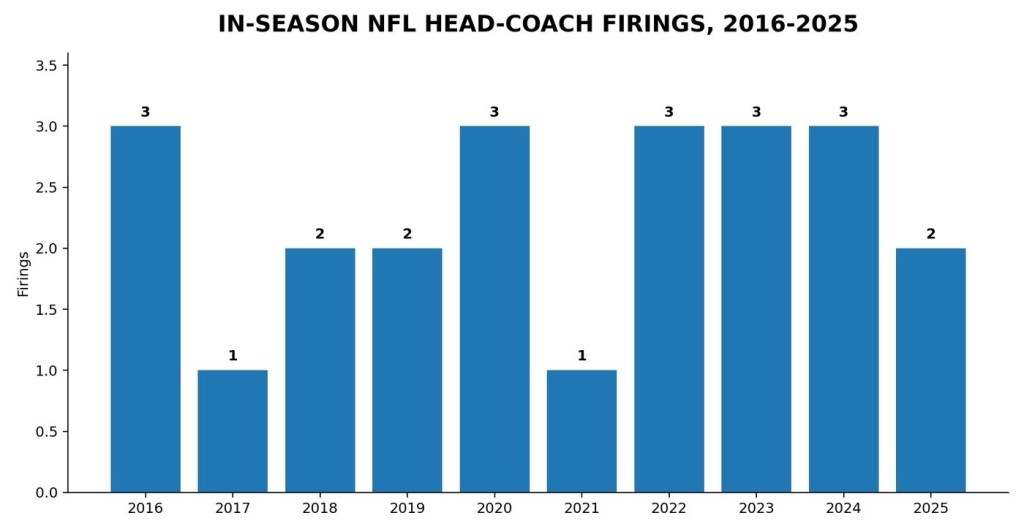
The timing has changed too. Jeff Fisher survived until after Week 14 in 2016 and Ben McAdoo until after Week 13 in 2017. By 2019 Jay Gruden was gone after Week 5; Bill O’Brien went after Week 4 in 2020; Matt Rhule made it five weeks in 2022; Robert Saleh made it five in 2024; Brian Callahan made it six last year.
Across the full decade, the first firing arrived after roughly Week 8. But from 2016–21 the average was Week 9.7; from 2022–25 it was Week 6.
We used to wait until Christmas to fire football coaches. Now you can lose your health insurance before the leaves change.
Side note – holy shit. Holy fucking shit. I am editing this article and getting the graphs in order while I am on a boat Labor Day weekend (brag). A mutual friend just shit herself on the boat! My friend’s friend pooped her pants. The seats of the boat are all white. She didn’t realize she did it and changed seats and someone else sat in her shit. This can’t go on like this. There’s shit everywhere on this nice white boat. It looks like the Menendez brothers’ crime scene if they used miralax instead of guns.
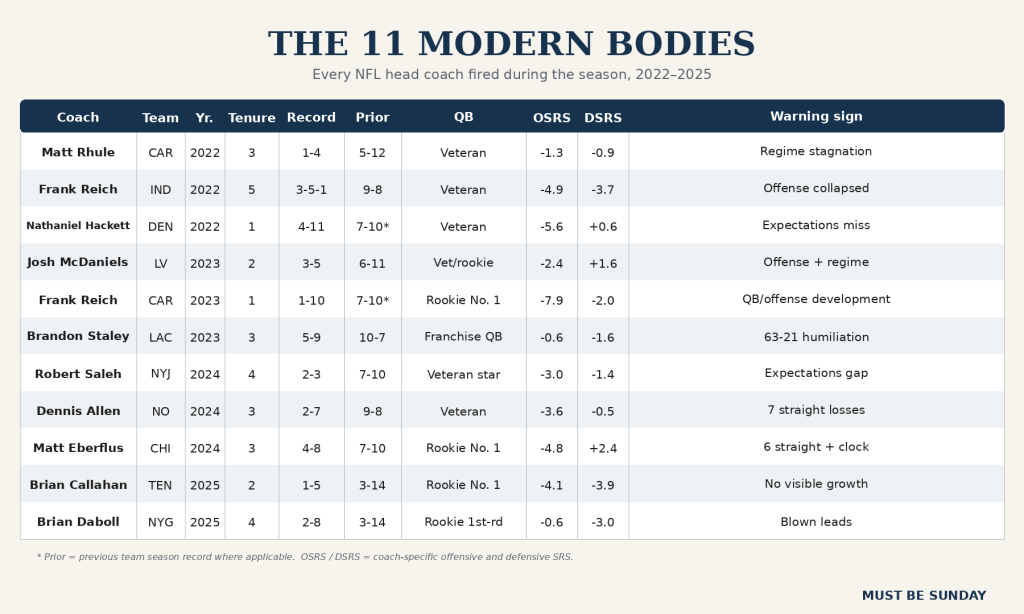
I narrowed the real investigation to 2022 through 2025: Matt Rhule, Frank Reich, Nathaniel Hackett, Josh McDaniels, Frank Reich again—which feels greedy—Brandon Staley, Robert Saleh, Dennis Allen, Matt Eberflus, Brian Callahan and Brian Daboll.
Eleven men.
Four seasons.
We have bodies. Now we need causes.
THE 11 MODERN BODIES
Before building a formula, here is the actual modern sample. These are the 11 in-season firings from 2022 through 2025 and the conditions surrounding each one. The point is not that every firing looks identical. The point is to find the things that keep showing up.
The offense is usually fucked.
This was the biggest finding.
All 11 modern coaches had a negative coach-specific Offensive SRS during the games they coached.
Every single one.
Defense was different. Hackett, McDaniels and Eberflus were all fired while their teams had positive Defensive SRS marks. Apparently you can survive having a decent defense. You cannot repeatedly send an offense onto an NFL field looking like 11 strangers who met in the parking lot.
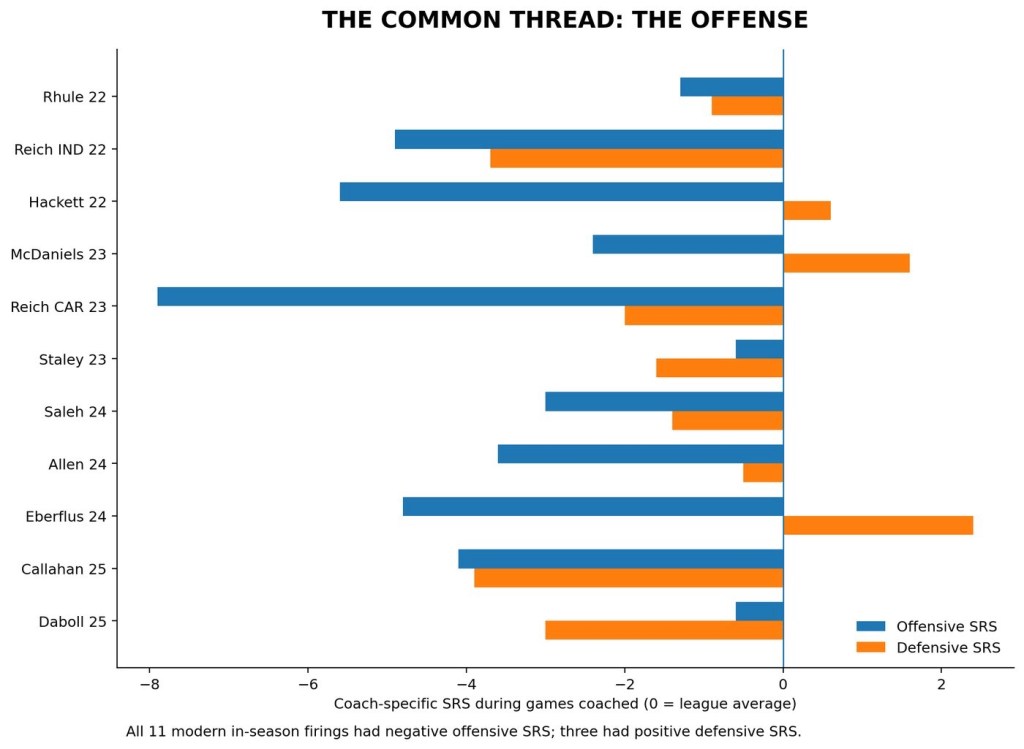
All 11 modern firings had a below-average offensive SRS. Bad defense was not nearly as universal.
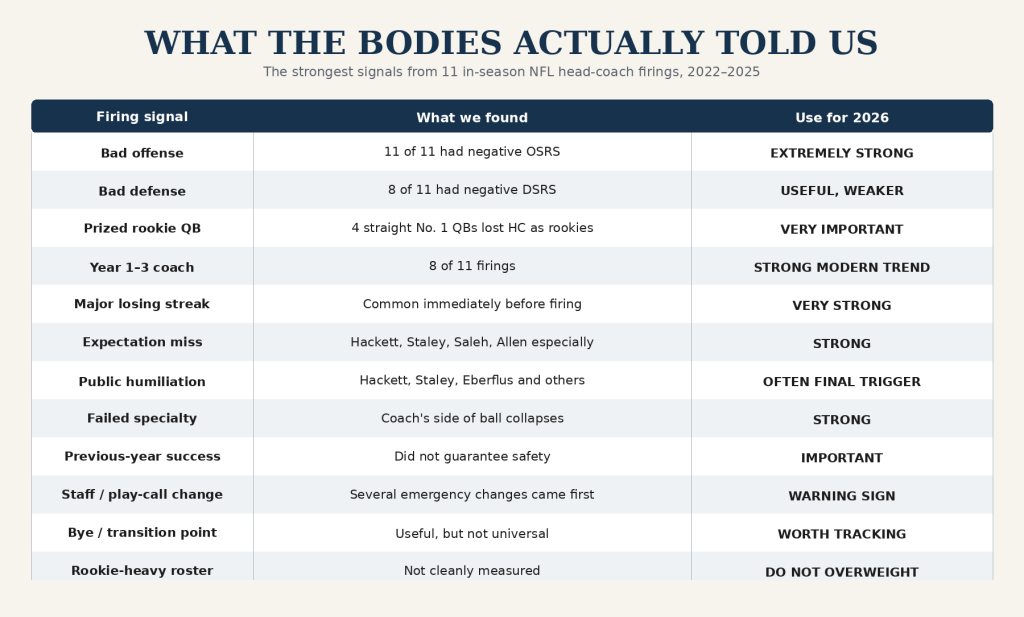
The rest of the pattern followed. Rookie quarterbacks were not shields. Losing streaks mattered independently of the overall record. Expectation misses were extremely dangerous. Public humiliation frequently supplied the final push. Coaches whose supposed area of expertise collapsed were particularly vulnerable. And changing a coordinator, quarterback or play caller often looked less like a solution than the organization trying the last available button before pressing the large red one marked FIRE COACH.
THE ROOKIE QB IS NOT A HUMAN SHIELD
The useful way to think about this is not “rookie quarterback equals coach fired.”
The signal is organizational asset protection.
Trevor Lawrence, Bryce Young, Caleb Williams and Cam Ward were four consecutive No. 1 overall quarterbacks. All four had their head coach fired during their rookie season.
That is fucking insane.
But it also makes sense. If an NFL franchise spends the most valuable draft pick it possesses on a quarterback and six weeks later begins wondering whether the adults teaching him know what they’re doing, ownership does not sacrifice the quarterback. It changes the adults.
That matters in 2026 because Las Vegas just drafted Fernando Mendoza No. 1 overall. He will not open the year as the starter—Klint Kubiak named Kirk Cousins QB1—but Mendoza is now an organizational asset worth monitoring.
We will come back to him.
WE HAVE LEARNED HOW NFL COACHES DIE
At this point I had spent an amount of time researching fired football coaches that would concern my family if they knew about it.
But I had patterns: bad offense, bad record, expectations collapsing, losing streaks, failed specialties, quarterback urgency, impatient owners, emergency staff changes and schedules capable of turning a bad start into a public execution.
There was only one responsible thing left to do.
Build a formula.
THE MUST BE SUNDAY COACH TERMINATION INDEX™
The MBS Coach Termination Index is a 100-point measurement of relative in-season firing risk.
A score of 73 does not mean a coach has a 73% chance of being fired. We have 11 modern observations, a laptop and no peer review. I am irresponsible, not dishonest.
The model has six main categories, 19 component variables and 100 total points.
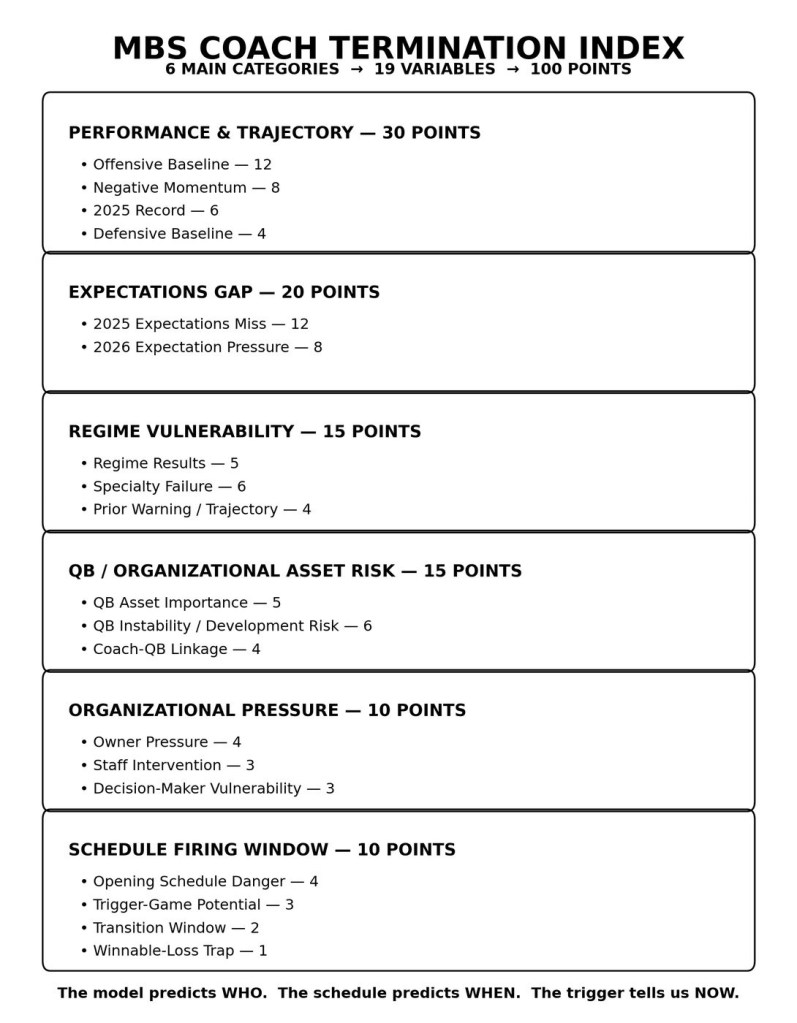
Those six buckets sound nice, but this is journalism. We can’t just give Todd Bowles a 17/20 in “bad vibes.” So each bucket gets broken into specific weighted variables.
Performance & Trajectory — 30 points
- Offensive Baseline — 12
- Negative Momentum — 8
- 2025 Record — 6
- Defensive Baseline — 4
Expectations Gap — 20 points
- 2025 Expectations Miss — 12
- 2026 Expectation Pressure — 8
Regime Vulnerability — 15 points
- Regime Results — 5
- Specialty Failure — 6
- Prior Warning / Trajectory — 4
QB / Organizational Asset Risk — 15 points
- QB Asset Importance — 5
- QB Instability / Development Risk — 6
- Coach-QB Linkage — 4
Organizational Pressure — 10 points
- Owner Pressure — 4
- Staff Intervention — 3
- Decision-Maker Vulnerability — 3
Schedule Firing Window — 10 points
- Opening Schedule Danger — 4
- Trigger-Game Potential — 3
- Transition Window — 2
- Winnable-Loss Trap — 1
The weighting matters. Offense alone is worth more than the entire schedule section because the historical evidence says bad offense is a defining trait while a convenient bye week is merely a convenient place to fire somebody.
HOW WE BUILT THE DEATH MACHINE
At this point, we had our causes of death. Now we needed to turn them into math.
The 19 variables in the MBS Coach Termination Index were not selected because I enjoy assigning numbers to the job security of strangers. Although I have discovered that I very much enjoy doing that.
They came directly from what kept showing up in the 11 modern firings.
But the research also told us something important: not every warning sign deserves equal weight.
If we gave everything the same number of points, a conveniently located bye week would matter as much as having one of the worst offenses in football. That would be insane. Even for us.
So the warning signs were grouped into six larger categories, and those categories were weighted based on two things: how consistently the underlying signals appeared in the recent firings and how directly they seemed connected to the decision to fire the coach.
Performance & Trajectory gets 30 points because actual football failure was the strongest signal we found. More specifically, offensive failure was the closest thing this investigation produced to a universal cause of death. All 11 coaches fired from 2022 through 2025 had a negative offensive SRS during the games they coached. Defensive failure mattered too, but it wasn’t universal: three coaches were fired despite above-average defensive SRS.
That’s why Offensive Baseline is worth 12 points while Defensive Baseline is worth only four. Negative Momentum gets eight because the recent firings repeatedly showed us that how a team arrives at its record matters. A seven-game losing streak creates a different kind of organizational panic than seven losses scattered across four months. The previous year’s record gets the remaining six.
Expectations Gap gets 20 points because NFL owners don’t judge records in a vacuum. Robert Saleh was fired at 2-3. Nathaniel Hackett made it to 4-11. The record alone doesn’t explain that.
The difference is the distance between what an organization believed it had in August and what it was staring at by October.
A rebuilding team being bad is disappointing. A supposed contender being bad is an emergency.
So 12 points measure the previous season’s expectations miss, while another eight measure the expectation pressure entering 2026. A coach who already disappointed ownership and is being asked to contend now is standing considerably closer to the trapdoor.
Regime Vulnerability gets 15 points because failure accumulates. Eight of our 11 modern firings involved coaches in Years 1 through 3, but simply counting years doesn’t tell us enough. We also need to know what the regime has actually accomplished, whether things are getting worse and, critically, whether the coach is failing at the thing he was hired to fix.
If you’re an offensive coach and your offense can’t cross midfield, that’s different from inheriting somebody else’s disaster.
So those 15 points are divided between Regime Results (5), Specialty Failure (6) and Prior Warning/Trajectory (4). Specialty failure gets the largest share because when the coach’s supposed area of expertise becomes part of the problem, his reason for being there starts disappearing.
QB / Organizational Asset Risk gets 15 points because the league has repeatedly demonstrated that it will protect the quarterback before it protects the coach.
Four consecutive No. 1 overall quarterbacks — Trevor Lawrence, Bryce Young, Caleb Williams and Cam Ward — lost their head coach during their rookie season. That doesn’t mean rookie quarterbacks get coaches fired. It means an extremely valuable young quarterback can accelerate the decision when ownership starts wondering whether the wrong coach is responsible for developing him.
The quarterback isn’t necessarily protecting the coach.
Sometimes he’s the asset ownership is trying to rescue.
So we measure QB Asset Importance (5), QB Instability/Development Risk (6) and Coach-QB Linkage (4). A struggling third-round rookie and a struggling No. 1 overall pick are not the same organizational emergency, and a coach specifically hired to develop that quarterback carries more exposure than one who happened to inherit him.
Organizational Pressure gets 10 points because football teams aren’t spreadsheets.
Somebody still has to actually fire the guy.
An impatient owner matters. A coordinator already being sacrificed matters. A head coach suddenly surrendering play-calling duties matters. A general manager wondering whether the next organizational failure is going to be blamed on him matters.
That’s why this category becomes Owner Pressure (4), Staff Intervention (3) and Decision-Maker Vulnerability (3).
Some 3-6 coaches are in trouble.
Some 3-6 coaches work for David Tepper.
These are not the same thing.
Finally, Schedule Firing Window gets only 10 points, and that’s deliberate.
This is where it would be easiest to bullshit ourselves.
A brutal opening schedule can accelerate a crisis. A nationally televised embarrassment can become the final piece of evidence. A bye week can give ownership a convenient transition point. Losing a game you absolutely should win can make everybody insane.
But the schedule should help us predict when a vulnerable coach gets fired.
It should not convince us that a perfectly secure coach is secretly doomed because he plays the Chiefs in October.
So schedule accounts for only 10% of the index: Opening Schedule Danger (4), Trigger-Game Potential (3), Transition Window (2) and Winnable-Loss Trap (1).
That gets us to six main categories, 19 component variables and 100 possible points.
The six categories are the theory.
The 19 variables are how we stop ourselves from cheating.
Because “Organizational Pressure: 8/10” sounds scientific until you realize I could just give Todd Bowles eight points because I don’t like the look on his face. Breaking it into Owner Pressure, Staff Intervention and Decision-Maker Vulnerability forces us to explain where every point actually came from.
The same thing happens across the model. “Performance is bad” becomes four different measurements. “Quarterback situation is scary” becomes three. “The schedule looks dangerous” becomes four.
Every point needs a home.
Every point needs a reason.
This is journalism.
One important distinction before we start scoring people: the MBS Coach Termination Index is a risk index. It is not a probability.
A score of 73 does not mean a coach has a 73% chance of getting fired. It means he accumulated 73 of the 100 possible preseason risk points created by this methodology.
And there is one thing we found in the historical data that the preseason model cannot know yet.
The trigger.
Nathaniel Hackett had the 51-14 Christmas disaster. Brandon Staley had 63-21 on Thursday Night Football. Matt Eberflus had the Thanksgiving clock-management catastrophe. Again and again, a vulnerable coach eventually produced one game that made the situation immediately indefensible.
We can’t score a humiliation that hasn’t happened yet.
So once the season begins, those events become what we’re calling the Trigger Override: the blowout, historically inept offensive performance, clock catastrophe, humiliating loss to a bad opponent, public owner criticism, coordinator firing or repeated blown lead that can turn an already-dangerous score into a firing.
Which gives us the final rule of the entire operation:
The model predicts WHO.
The schedule predicts WHEN.
The trigger tells us NOW.
Now we can start predicting.
BRING OUT THE PRISONERS
I fed all 32 coaches into the machine.
Not literally. That would be illegal. Probably.
The final preseason board came back:
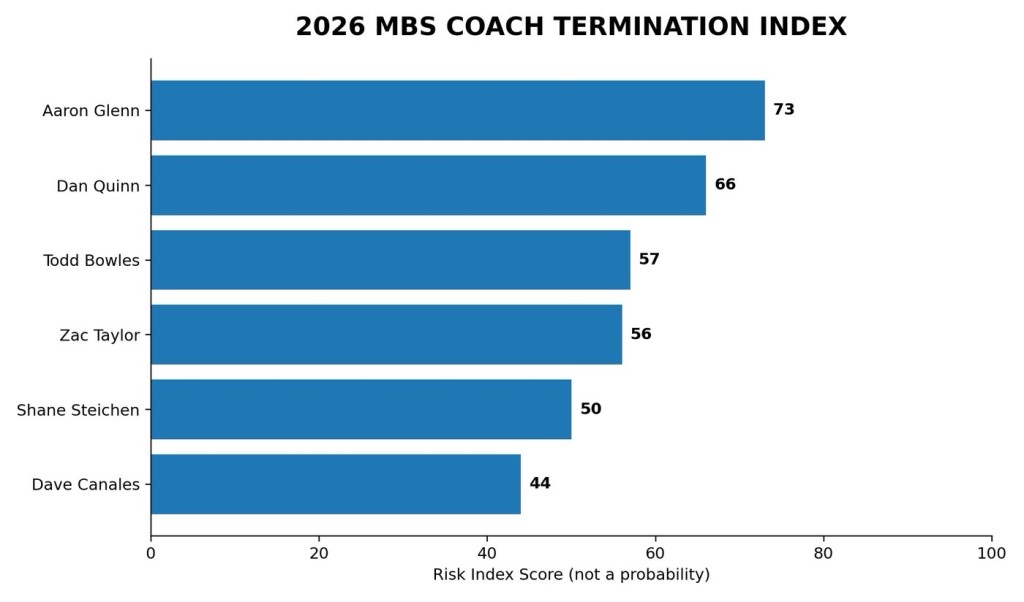
Aaron Glenn 73. Dan Quinn 66. Todd Bowles 57. Zac Taylor 56. Shane Steichen 50. Dave Canales 44.
Before making the final predictions, I also ran the two obvious rookie-QB-adjacent first-year coaches through the same machine.
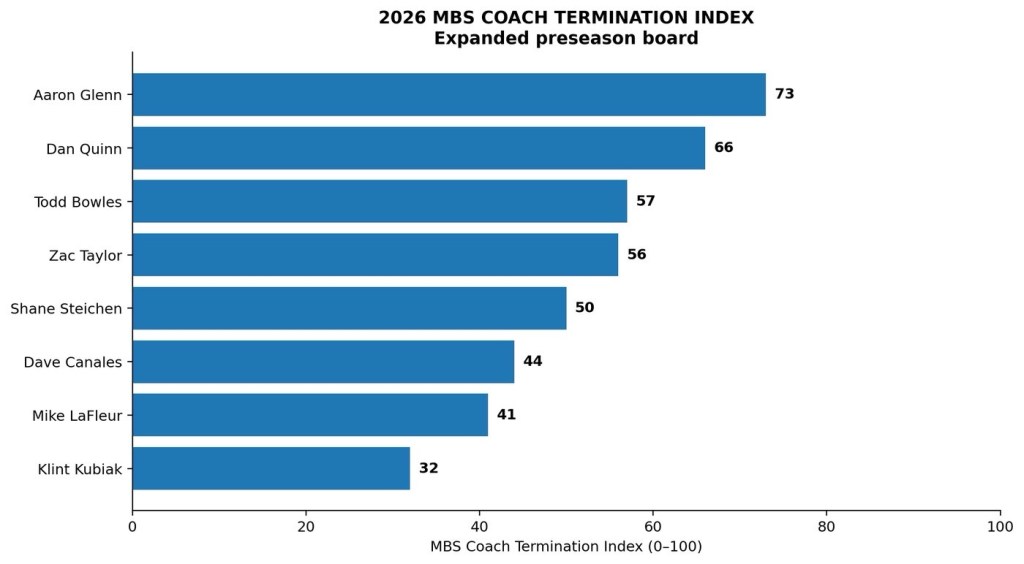
The model did not panic.
I am choosing to interpret this as evidence of scientific integrity.
AARON GLENN — NEW YORK JETS
MBS TERMINATION INDEX: 73
Glenn is the model’s clear preseason leader, but not because we typed “Jets suck” into a spreadsheet and went to lunch.
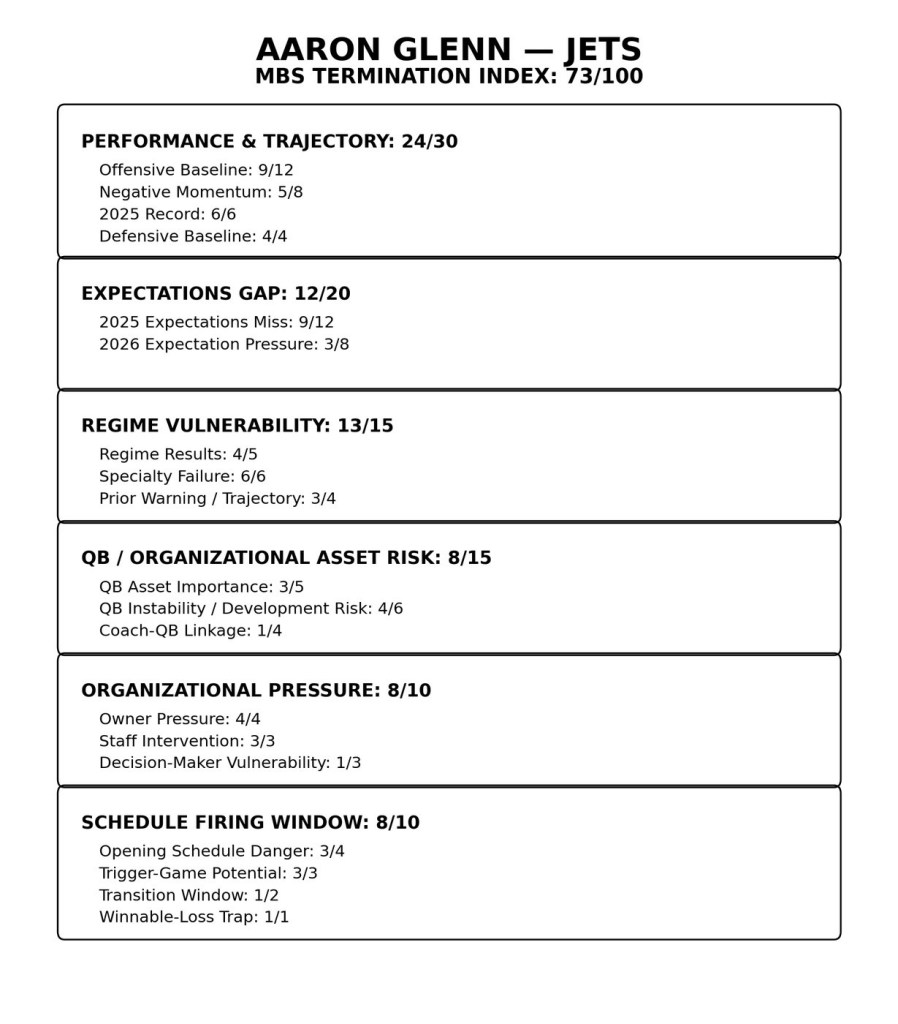
Performance & Trajectory — 24/30. Glenn starts with 9/12 for Offensive Baseline because the 2025 offense was horrific—17.6 points per game, 29th in the league—but the Jets did not simply run it back. Frank Reich replaced Tanner Engstrand, Geno Smith replaced Justin Fields, Garrett Wilson returns, and the Jets added first-round weapons Kenyon Sadiq and Omar Cooper Jr. Negative Momentum is 5/8, the 3-14 record gets the full 6/6, and the defense gets 4/4 after allowing 29.6 points per game.
Expectations Gap — 12/20. The Jets get 9/12 for the 2025 Expectations Miss. Their preseason win total was 6.5; they won three. The 2026 pressure is only 3/8 because nobody sane expects a Super Bowl. This is important: Glenn is not in danger because the Jets are supposed to win 12 games. He is in danger because another three-win season would suggest the entire operation is going nowhere.
Regime Vulnerability — 13/15. This is where Glenn’s score explodes. Regime Results are 4/5 because his only completed season is 3-14. Specialty Failure is the full 6/6 because Glenn is a defensive coach and his defense was one of the league’s worst. Prior Warning/Trajectory is 3/4 because Year 1 bought him another season but did not buy him patience forever.
QB / Organizational Asset Risk — 8/15. QB Asset Importance is 3/5. Geno matters, but this isn’t Joe Burrow or a No. 1 rookie. Instability/Development Risk is 4/6 because the Jets have changed quarterbacks and systems again. Coach-QB Linkage is only 1/4 because Glenn’s personal résumé is not built around quarterback development.
Organizational Pressure — 8/10. Owner Pressure is 4/4 because this is still the Jets and Woody Johnson has already demonstrated that a coach does not need to reach Thanksgiving if expectations collapse. Staff Intervention is 3/3 because the offensive structure has already been overhauled. Decision-Maker Vulnerability is only 1/3 because this is still a relatively new regime.
Schedule Firing Window — 8/10. Tennessee is winnable, but Green Bay, Detroit, Chicago and New England can turn a bad September into a 1-5 October quickly. And there is no convenient early bye to save him.
The most important offseason development may be Glenn taking over the defensive play calling himself. He called it his “superpower.”
That is excellent for us.
If the defense sucks now, we don’t even have to locate a scapegoat.
DAN QUINN —WASHINGTON COMMANDERS
MBS TERMINATION INDEX: 66
Quinn is the model’s surprise. A coach only two seasons removed from an NFC Championship Game should not ordinarily be sitting at 66, but Washington combines the largest expectations miss on the board with a defensive coach whose defense collapsed.
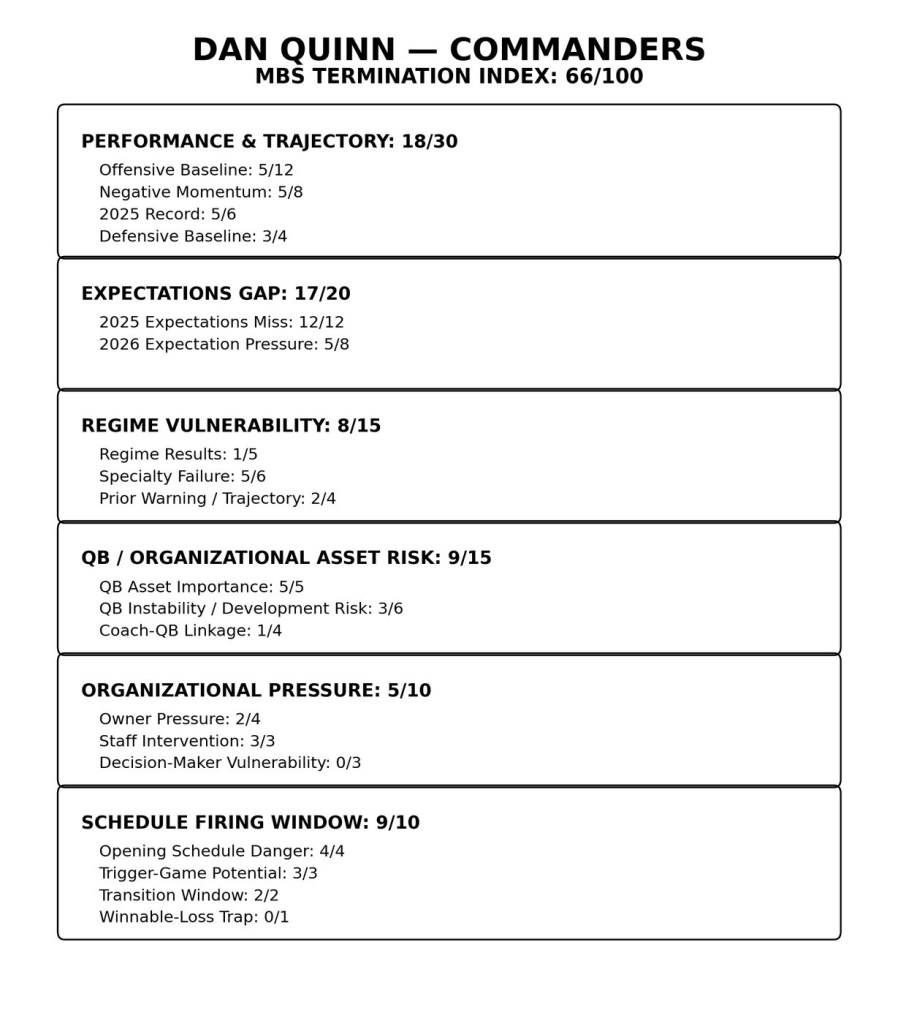
Performance & Trajectory — 18/30. Washington gets 5/12 for Offensive Baseline. The 2025 offense fell to 20.9 points per game, but Jayden Daniels missed time and the organization responded by replacing Kliff Kingsbury with David Blough while adding Stefon Diggs, Rachaad White and Chig Okonkwo. Negative Momentum is 5/8, the 5-12 record gets 5/6, and the defense gets 3/4 after allowing 26.5 per game.
Expectations Gap — 17/20. This is Quinn’s nuclear category. Washington carried a 9.5-win total and won five after reaching the NFC title game: 12/12. The 2026 pressure is another 5/8 because Daniels is a franchise quarterback and the organization is no longer grading itself like a rebuild.
Regime Vulnerability — 8/15. Regime Results are just 1/5 because that 2024 NFC Championship run is enormous credit in the bank. Specialty Failure is 5/6 because Quinn is a defensive head coach and the defense was bad. Prior Warning/Trajectory gets 2/4 because 2025 was an alarming reversal rather than years of failure.
QB / Organizational Asset Risk — 9/15. Daniels gives Quinn the full 5/5 for QB Asset Importance. Instability/Development Risk is 3/6 because injuries disrupted Year 2 and the offense is changing coordinators. Coach-QB Linkage is only 1/4 because Quinn is not the offensive architect.
Organizational Pressure — 5/10. Owner Pressure is 2/4. Staff Intervention is the full 3/3 because both coordinators were changed. Decision-Maker Vulnerability is 0/3 because Adam Peters remains secure enough that we don’t need to manufacture front-office panic.
Schedule Firing Window — 9/10. Philadelphia, Dallas, Seattle, Indianapolis in London, the Giants and then San Francisco. Trigger-Game Potential is 3/3 because Week 6 is Monday Night Football. Transition Window is 2/2 because the bye immediately follows.
This schedule looks less like a football schedule than a congressional investigation.
TODD BOWLES — TAMPA BAY BUCCANEERS
MBS TERMINATION INDEX: 57
Bowles reaches 57 in a very different way. Tampa was not a disaster from September through January. It was a team that looked good enough to matter and then spent two months disintegrating.
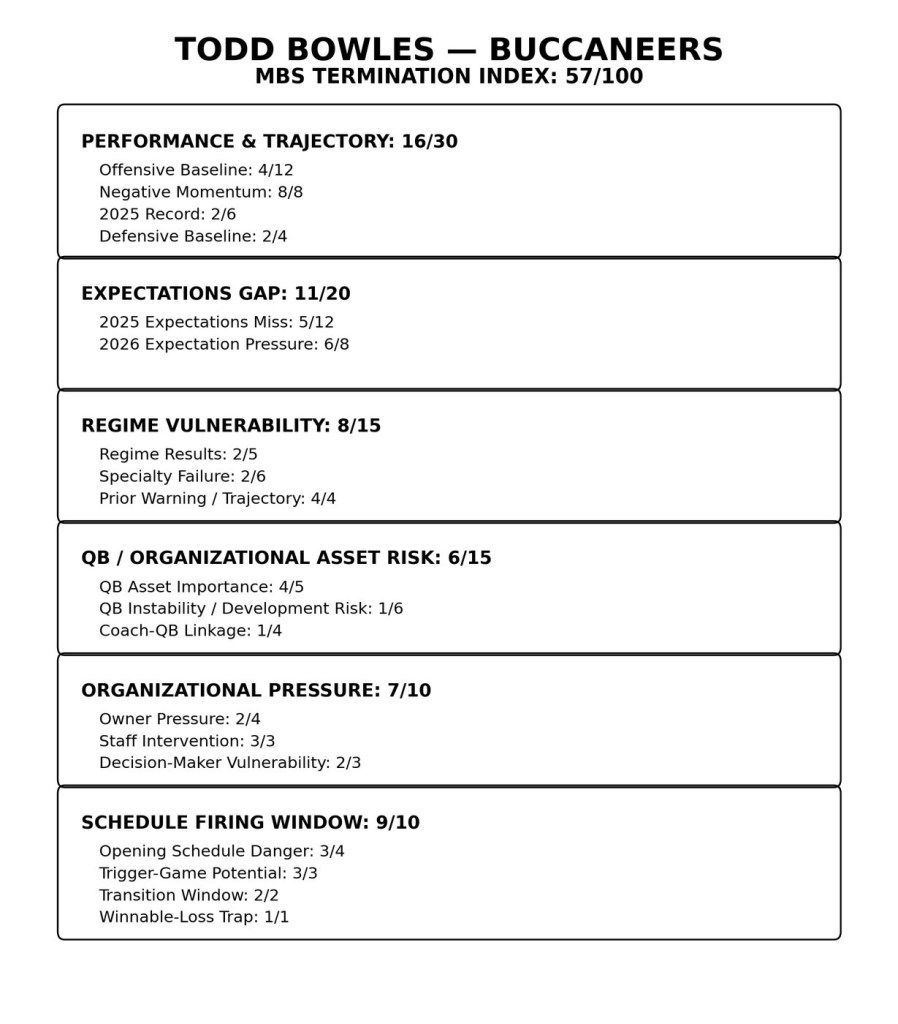
Performance & Trajectory — 16/30. Bowles gets only 4/12 for Offensive Baseline because Tampa’s 2025 offense was mediocre rather than catastrophic and the club responded by replacing Josh Grizzard with Zac Robinson. Negative Momentum, however, is 8/8. Tampa started 6-2 and lost seven of its final nine. The 8-9 record gets 2/6 and the defense gets 2/4.
Expectations Gap — 11/20. The 2025 miss gets 5/12. Tampa’s 9.5-win total versus eight actual wins is disappointing but not catastrophic. The 2026 pressure gets 6/8 because this is an established roster that expects to compete.
Regime Vulnerability — 8/15. Bowles has division titles and playoff wins, so Regime Results are only 2/5. Specialty Failure is 2/6. Prior Warning/Trajectory is the full 4/4 because that 2025 collapse is exactly the kind of thing that follows a coach into the next season.
QB / Organizational Asset Risk — 6/15. Baker Mayfield is important enough for 4/5, but there is only 1/6 for instability because he is an established veteran. Coach-QB Linkage is another 1/4.
Organizational Pressure — 7/10. The Glazers have historically been more patient than some owners, so Owner Pressure is 2/4. Staff Intervention is 3/3 because the offensive coordinator has already been changed. Decision-Maker Vulnerability is 2/3.
Schedule Firing Window — 9/10. This is where Bowles becomes fascinating. Week 9 is at Chicago on Sunday Night Football.
Week 10 is the bye.
Todd Bowles. Soldier Field. Sunday night. 3-6. Bye week starting the following morning.
If I were drawing a head-coach murder mystery on a whiteboard, I would consider this excessive foreshadowing.
ZAC TAYLOR — CINCINNATI BENGALS
MBS TERMINATION INDEX: 56
Taylor’s 56 is a useful stress test for the model. The record, expectations and Burrow urgency scream danger. The functioning offense and one of the NFL’s most patient ownership structures scream restraint.
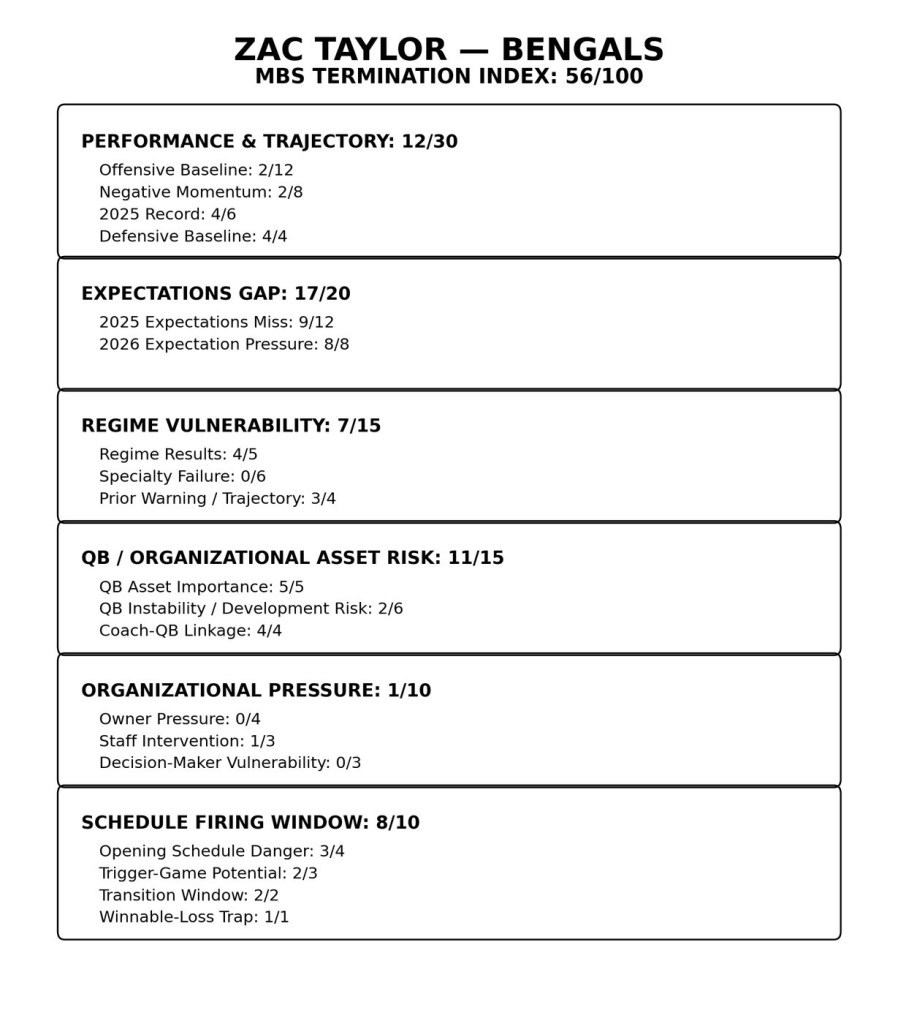
Performance & Trajectory — 12/30. Taylor gets only 2/12 for Offensive Baseline because Cincinnati’s offense remained functional despite Joe Burrow missing nine games. Negative Momentum is 2/8, the 6-11 record gets 4/6 and the terrible defense gets 4/4.
Expectations Gap — 17/20. Cincinnati gets 9/12 for missing 2025 expectations and the full 8/8 for 2026 pressure. Burrow, Ja’Marr Chase and Tee Higgins mean the franchise is supposed to be competing for championships.
Regime Vulnerability — 7/15. Regime Results are 4/5 because three straight missed postseasons have eroded the credit from the Super Bowl run. Specialty Failure is 0/6 because Taylor is an offensive coach and the offense still works. Prior Warning gets 3/4.
QB / Organizational Asset Risk — 11/15. Burrow gets 5/5 for importance. Development/instability is only 2/6 because he is already elite, but repeated injuries increase the urgency to maximize healthy seasons. Coach-QB Linkage is the full 4/4.
Organizational Pressure — 1/10. And here is the giant brake. Mike Brown publicly backed Taylor and Duke Tobin after 2025. Owner Pressure: 0/4. Staff Intervention: 1/3. Decision-Maker Vulnerability: 0/3.
Schedule Firing Window — 8/10. The Week 6 bye is the key. If Cincinnati somehow opens 1-4 against Tampa Bay, Houston, Pittsburgh, Jacksonville and Miami, we have a situation.
But the model is telling us something important: do not confuse an angry fan base with an owner who is prepared to fire somebody.
SHANE STEICHEN — INDIANAPOLIS COLTS
MBS TERMINATION INDEX: 50
Steichen is the coach the model talked me out of killing.
The seven-game collapse looks fatal until you remember his offense was one of the best in football and the Colts actually beat their preseason win total.
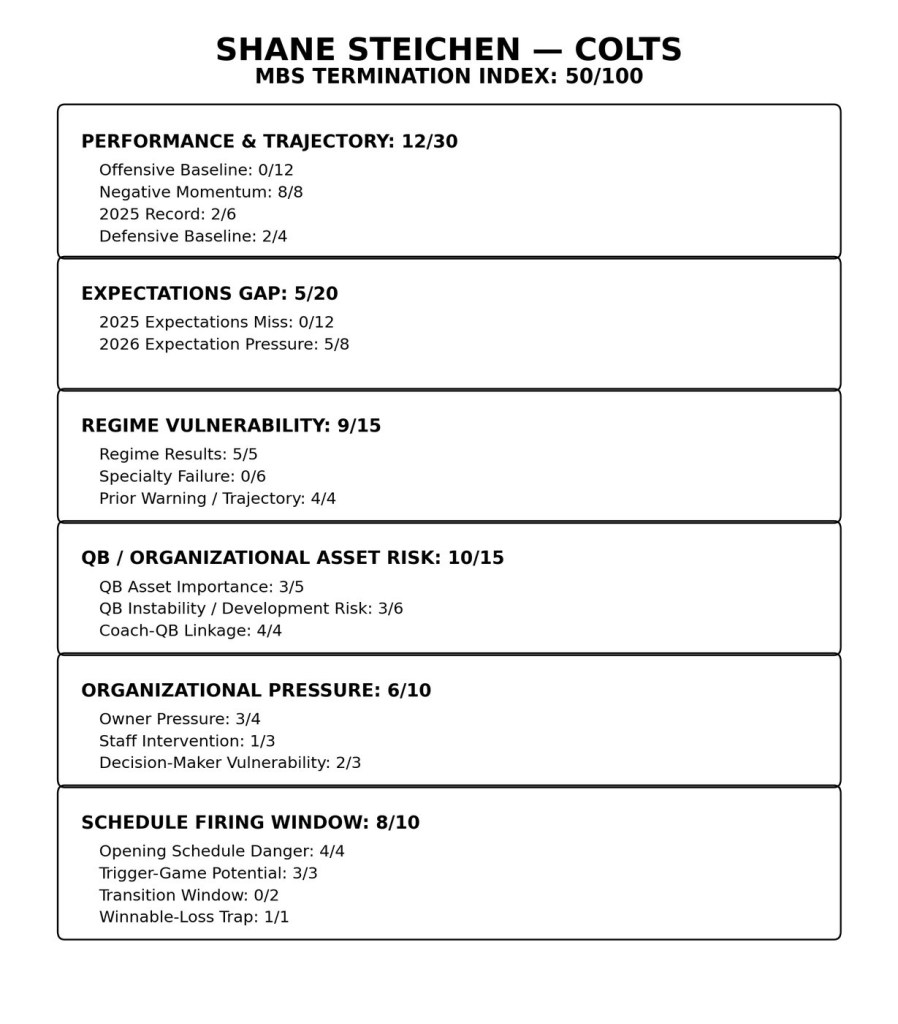
Performance & Trajectory — 12/30. Steichen gets 0/12 for Offensive Baseline because the 2025 Colts offense was legitimately excellent: eighth in scoring, second in points per drive and top ten across a long list of efficiency categories. Negative Momentum is the full 8/8 because they lost seven straight. The 8-9 record gets 2/6 and the defense 2/4.
Expectations Gap — 5/20. The 2025 miss is 0/12 because Indianapolis entered with a 7.5-win total and won eight. The season felt disastrous because of how it ended, not because it failed preseason expectations. The 2026 pressure gets 5/8.
Regime Vulnerability — 9/15. Regime Results are 5/5 because Steichen is 25-26 through three seasons with no playoff berth. Specialty Failure is 0/6 because his offense is the exact opposite of a specialty failure. Prior Warning is 4/4 because seven consecutive losses tend to leave a mark.
QB / Organizational Asset Risk — 10/15. Daniel Jones gets 3/5 for importance, 3/6 for instability and Steichen gets 4/4 for Coach-QB Linkage because quarterback/offensive performance is his job.
Organizational Pressure — 6/10. Owner Pressure is 3/4 after Carlie Irsay-Gordon publicly expressed her displeasure with the late collapse. Staff Intervention is 1/3. Decision-Maker Vulnerability is 2/3.
Schedule Firing Window — 8/10. Baltimore, Kansas City, Houston, Washington in London and Pittsburgh open the year. Tennessee at home in Week 6 is the potential trigger.
Steichen is exactly why we built the formula instead of simply sorting coaches by “people on Twitter seem mad.”
DAVE CANALES — CAROLINA PANTHERS
MBS TERMINATION INDEX: 44
Canales finishes at 44 because the model is not allowed to confuse David Tepper’s personality with evidence that the coach deserves to be fired.
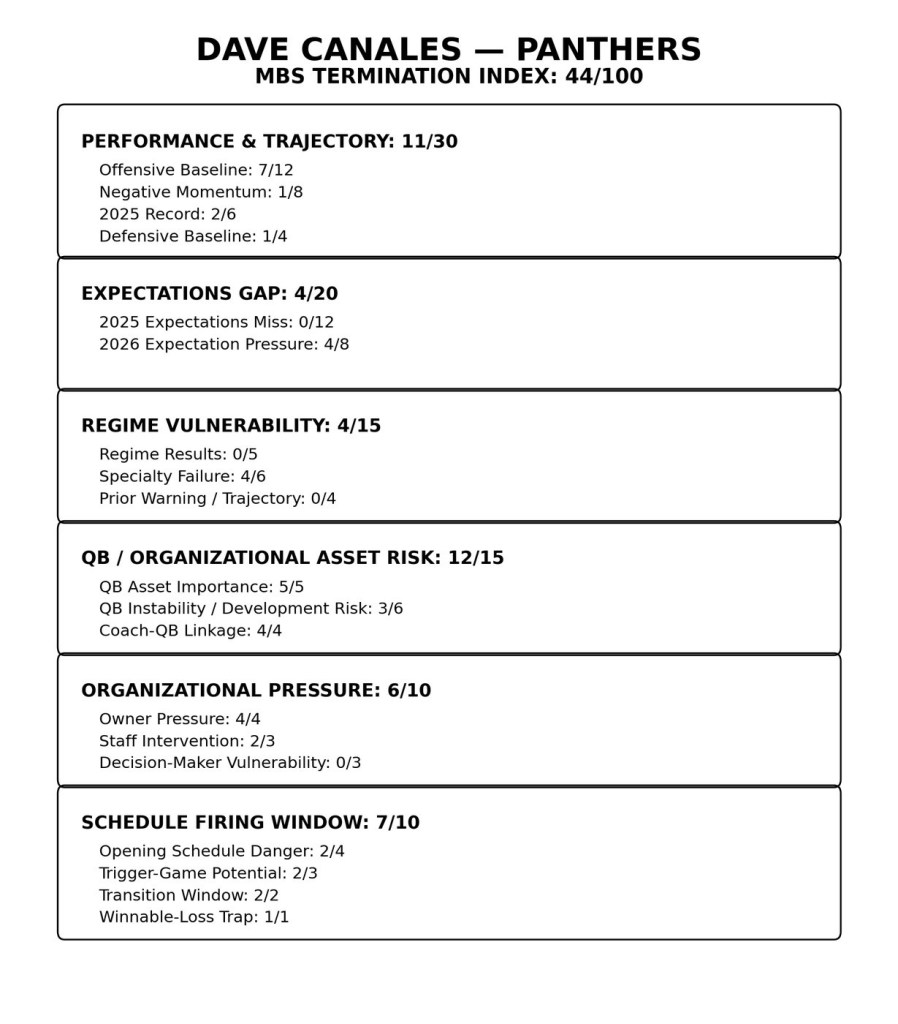
Performance & Trajectory — 11/30. Canales gets 7/12 for Offensive Baseline because Carolina still scored only 18.3 points per game in 2025, and Brad Idzik is now taking over play-calling. Negative Momentum is just 1/8, the record gets 2/6 and the defense 1/4.
Expectations Gap — 4/20. This is his shield. Carolina entered with a 6.5-win total, won eight, captured the NFC South and made the playoffs. That’s 0/12 for the 2025 Expectations Miss. Pressure rises modestly in 2026, hence 4/8.
Regime Vulnerability — 4/15. Canales has taken Carolina from five wins to eight and a playoff berth, so Regime Results are 0/5. Specialty Failure gets 4/6 because he is an offensive coach and the offense remains the obvious weakness. Prior Warning is 0/4.
QB / Organizational Asset Risk — 12/15. Bryce Young produces the full 5/5 for importance and 4/4 for Coach-QB Linkage. Instability/Development Risk is 3/6.
Organizational Pressure — 6/10. Owner Pressure is 4/4 because David Tepper’s history requires no imagination. Staff Intervention gets 2/3 after Canales handed play-calling to Idzik. Decision-Maker Vulnerability is 0/3.
Schedule Firing Window — 7/10. Carolina gets Chicago, Atlanta, Cleveland and Detroit before an early Week 5 bye. That gives ownership a clean evaluation point.
But firing Canales after the trajectory Carolina has shown would require something catastrophic.
Which, again, is why David Tepper keeps the score from being 31.
WE CHECKED THE ROOKIE-QB TEAMS
The historical quarterback finding was too strong to leave sitting in a table. So before signing the death certificates, I ran Klint Kubiak and Mike LaFleur through the exact same index.
KLINT KUBIAK — LAS VEGAS RAIDERS: 32/100
Las Vegas is coming off 3-14 and an atrocious offense, but Kubiak did not create any of it.
He is a first-year head coach arriving from a Seattle offense that ranked third in scoring during a championship season. That gives him enormous protection in the regime and expectations categories.
You cannot fire Pete Carroll and then charge the replacement with Pete Carroll’s crimes.
The interesting number is QB / Organizational Asset Risk: 10/15. Fernando Mendoza is the No. 1 overall pick and therefore the future of the franchise, while Kubiak is an offensive head coach. But Kubiak named Kirk Cousins the Week 1 starter, which gives everybody time.
Raiders start 2-5, Mendoza takes over, offense remains awful and Mendoza looks lost?
Reopen the file immediately.
MIKE LAFLEUR — ARIZONA CARDINALS: 41/100
Arizona is more interesting.
LaFleur is also a first-year coach inheriting a 3-14 team, so he gets the same basic protection against blaming him for last year’s wreckage. But the organization just changed coaches after a season in which expectations were considerably higher, and Monti Ossenfort survived the previous regime.
Carson Beck matters, but not the way Mendoza does. Beck is a third-round investment, not the No. 1 overall pick, and Arizona’s veteran quarterback situation means we should not pretend this is Bryce Young or Caleb Williams.
The model checked the rookies.
The model did not panic.
Science lives another day.
NOW LET’S MAKE SOME PREDICTIONS
We have identified the men most at risk.
Now comes the reason I started this entire investigation.
I don’t want “hot seat.”
I want dates.
So I took the highest-risk coaches and went through their schedules looking for three things:
- The bad start.
- The trigger loss.
- The transition window.
History tells us who gets fired.
The schedule tells us where it happens.
PREDICTION NO. 1: AARON GLENN — FIRED MONDAY, OCTOBER 19
The Jets open at Tennessee, then Green Bay, at Detroit, at Chicago, Cleveland and at New England.
I think they arrive in Foxborough 1-4.
The new offense looks better in flashes but not enough, the defense remains the problem, and Drake Maye sends New York home 1-5.
This isn’t just because 1-5 is bad. It is because of what 1-5 would mean.
Glenn survived 3-14. He changed the offensive coordinator. Changed the quarterback. Added weapons. Changed the defensive structure. Took over defensive play-calling himself.
At some point there are no more buttons.
Aaron Glenn survives going 3-14. He does not survive losing to New England in October. America remains a land of second chances, provided you don’t require a third.
Monday, October 19, 2026: Aaron Glenn is fired.
PREDICTION NO. 2: DAN QUINN — FIRED TUESDAY, OCTOBER 20
Washington opens at Philadelphia, at Dallas, Seattle, Indianapolis in London, the Giants and then at San Francisco on Monday Night Football.
That is not a schedule.
That is CIA black site torture.
WHEN’S THE LAST TIME YOU SAW BIN LADEN!??!?!?
I think Washington reaches San Francisco 2-3, loses on national television and falls to 2-4.
And then Washington has a bye.
That is the part I cannot get past.
A defensive head coach coming off a 5-12 season, another poor defensive start, a nationally televised loss, then an empty week to install an interim staff?
That is not a bye week.
That is an HR appointment.
Tuesday, October 20, 2026: Dan Quinn is fired.
PREDICTION NO. 3: TODD BOWLES — FIRED MONDAY, NOVEMBER 9
Bowles is my favorite WHEN, even if he is not my strongest WHO.
Tampa can hang around through October. I think the Bucs arrive at Soldier Field for Week 9 Sunday Night Football at 3-5.
They lose.
They fall to 3-6.
And the bye begins the next morning.
Todd Bowles. Soldier Field. Sunday night. 3-6. Bye week.
If I were drawing a head-coach murder mystery on a whiteboard, I would consider this excessive foreshadowing.
Monday, November 9, 2026: Todd Bowles is fired.
If Tampa is 6-2 by then, congratulations Todd. I will destroy the documents.
If he’s 3-5 going into Chicago?
Call 11.
Get my table ready.
THE OFFICIAL MBS 2026 DEATH CERTIFICATES
Aaron Glenn — New York Jets
Cause of death: New England Patriots
Projected final record: 1-5
Time of death: Monday, October 19
Dan Quinn — Washington Commanders
Cause of death: San Francisco 49ers on Monday Night Football
Projected final record: 2-4
Time of death: Tuesday, October 20
Todd Bowles — Tampa Bay Buccaneers
Cause of death: Chicago Bears on Sunday Night Football
Projected final record: 3-6
Time of death: Monday, November 9
Two NFL head coaches fired within roughly 24 hours of each other in October is an aggressive prediction.
Good.
I did not spend all this time developing a 19-variable unemployment formula so I could finish by saying Todd Bowles is “one to monitor.”
For now, all 32 NFL head coaches are alive. They have their quarter-zips. They have their laminated play sheets. They have culture. They have plans.
History suggests two or three of them will not make it to January.
I have selected three.
History tells us who dies. The schedule tells us where the body will be found.
This is journalism.

