What 10 years of waiver-wire breakouts can teach us about 2026
Every September, fantasy football managers do the same thing.
We spend an entire summer obsessing over depth charts, training-camp reports, preseason usage, target shares, coaching changes and offensive line continuity. Then the games finally start, somebody we barely drafted scores 25 fantasy points, and approximately 80 percent of that work gets thrown directly into the garbage.
The Week 1 box score takes over.
A backup running back scores twice? He must be the guy now. A receiver catches a 70-yard touchdown? Better empty the FAAB account. A tight end nobody started finishes TE1? Surely we have discovered the next breakout.
Sometimes we have. A lot of the time, we haven’t.
And the hard part is that the two can look almost identical on Sunday night.
Consider two Rams.
In Week 1 of 2020, Malcolm Brown scored 26.0 PPR points against Dallas. He played 60 percent of the offensive snaps, handled 18 carries, caught three passes and scored two touchdowns. This wasn’t some garbage-time fluke in a 35-point blowout, either. The Rams won 20-17. Brown’s workload was legitimate. He played 44 snaps compared with 24 for rookie Cam Akers and five for Darrell Henderson.
Three years later, Puka Nacua opened his NFL career with 21.9 PPR points.
So if your waiver-wire process was simply sorting Week 1 fantasy points, Brown’s performance was actually better.
One became one of the defining waiver-wire pickups of the decade. The other finished RB43.
The difference wasn’t that Brown’s game was fake. It was that the opportunity wasn’t clearly his.
Akers had started the game and still received 15 touches. Henderson was working his way back from injury. Contemporary analysis at the time was already warning that Los Angeles had not actually settled its backfield.
Puka’s 21.9 points told a very different story. He saw 15 targets, caught 10 passes for 119 yards and did it without scoring a touchdown. His 44.1 percent target share was among the most striking usage signals of Week 1. Cooper Kupp was already known to be sidelined for at least four weeks.
Brown had a great game. Puka had revealed a job.
That distinction became the starting point for this project.
We studied 30 prominent post-Week-1 waiver targets across 10 seasons, from 2016 through 2025, three from every year, to answer a deceptively simple question: When a player explodes in Week 1, what actually tells us whether the breakout is going to last?
The answer was not fantasy points. It wasn’t touchdowns. It wasn’t even raw volume. The best clue was what Week 1 changed about the player’s job – and how much evidence we had that the opportunity actually belonged to him.
And this is not just a historical exercise. Before the 2026 season begins, I am freezing three names I think are most likely to trigger next Tuesday’s waiver frenzy: an Eagles receiver, a Seahawks running back rostered almost nowhere and a Dolphins receiver available in more than 90 percent of ESPN leagues. The point of the next several thousand words is to explain why – and to put the answers on the record before Sunday can make any of us look smarter than we were.
PART I — WHAT THE HISTORY SUGGESTS
How the 30-Player Historical Sample Was Built
This is not a study of every unrostered NFL player from the last decade. For each season from 2016 through 2025, I went back to the week immediately following the opener and identified what I believe were the three most prominent waiver-wire targets entering Week 2. The goal was not to find three players who make the framework look good in hindsight. It was to reconstruct the names fantasy managers were actually being told to add – and, where the historical data are recoverable, were actively adding – after opening weekend.
I used contemporary Week 2 waiver coverage and, where it could be reliably recovered, roster percentages and week-over-week roster movement. That produced a 30-player sample: three historically prominent post-Week-1 waiver targets from each season.
There is necessarily some judgment involved. No single authoritative cross-platform database tells us the exact three most-added players after Week 1 for every season going back to 2016, and historical transaction data become especially spotty in the earlier years. So I am not claiming these were definitively the three most-added players on every fantasy platform. They are my best reconstruction of the three most prominent Week 1 waiver targets from each season using the contemporary evidence available.
That distinction matters. This is a selected sample of players who had already generated a meaningful waiver conversation, not a random sample of available NFL players. We are studying the guys who made everyone open the waiver tab on Monday, not every backup with a pulse. The historical question is therefore narrower: among the players fantasy managers were already chasing after Week 1, what separated the ones worth chasing from the ones who weren’t?
| Season | Waiver targets |
|---|---|
| 2016 | Tyrell Williams, Tajae Sharpe, Jamison Crowder |
| 2017 | Tarik Cohen, Cooper Kupp, Kenny Golladay |
| 2018 | Phillip Lindsay, T.J. Yeldon, Quincy Enunwa |
| 2019 | Terry McLaurin, John Ross, Malcolm Brown |
| 2020 | Nyheim Hines, Malcolm Brown, Benny Snell |
| 2021 | Elijah Mitchell, Sterling Shepard, Christian Kirk |
| 2022 | Jeff Wilson Jr., Curtis Samuel, Robbie Anderson |
| 2023 | Puka Nacua, Kyren Williams, Tyler Allgeier |
| 2024 | J.K. Dobbins, Isaiah Likely, Jordan Mason |
| 2025 | Zach Charbonnet, Hollywood Brown, Dylan Sampson |
Then we classified what fantasy managers ultimately received: League Winner, Hit, Useful, Bust or Injury Loss.
The Injury Loss category matters. John Ross getting hurt after opening 2019 with 158 yards and two touchdowns shouldn’t teach us the same lesson as Malcolm Brown eventually losing work in a crowded backfield. One may have been a reasonable read ruined by injury. The other may have been a warning we could see coming.
Ground rule: only use information fantasy managers could reasonably know by Tuesday morning after Week 1.
No hindsight. No ‘well, obviously we know now.’ Who started? Who played? Who was hurt? How long was the absence expected to last? Was another player still heavily involved? Did the workload come in garbage time? Did the coach actually change the hierarchy, or did somebody just have a good afternoon?
That stricter audit changed several of our original evaluations. And it made the findings better.
The Week 1 Leaderboard Didn’t Have the Answer
Eventual League Winners averaged 19.2 PPR points in Week 1. Eventual Busts averaged 19.1.
The players who ultimately became the best waiver pickups in our 10-year sample and the players who eventually busted were separated by one tenth of a fantasy point in their opening games.
Even more surprisingly, none of the three League Winners finished among the top five scorers at his position in Week 1. Phillip Lindsay finished RB13. Puka Nacua finished WR9. Kyren Williams finished RB9.
Meanwhile, some of the loudest Week 1 performances led nowhere close to that. John Ross scored 34.8. Nyheim Hines scored 27.3. Malcolm Brown scored 26.0 in 2020. Isaiah Likely scored 26.1.
The Week 1 fantasy leaderboard was excellent at telling us what had just happened. It was much less useful at telling us what was about to happen — which is inconvenient, because fantasy managers are generally trying to win next week rather than last week.
Not: How many points did he score? Instead: What did his team just tell us about his job?
Opportunity Is Not the Same Thing as Ownership
This became one of the most important distinctions in the entire study.
Fantasy analysis naturally focuses on opportunity: carries, targets, routes, snaps and goal-line work. And it should. You cannot score fantasy points without getting the football.
But raw opportunity has a weakness. It tells us what a player received Sunday. It does not necessarily tell us whether he gets to keep it.
Malcolm Brown is the perfect example. He had 21 touches in Week 1 of 2020. That’s excellent usage. The problem wasn’t that the workload didn’t happen. It clearly did. The problem was that Cam Akers had started and received 15 touches of his own, while Darrell Henderson remained another viable member of the backfield.
Now compare that with Puka. Fifteen targets. Ten catches. 119 yards. A massive target share. And Cooper Kupp was already guaranteed to miss at least the first four weeks.
There was opportunity in both cases. But the evidence of near-term ownership was dramatically stronger with Puka.
SAME QUESTION, DIFFERENT ANSWER: OPPORTUNITY VS. OWNERSHIP
| PLAYER | WEEK 1 EVIDENCE | ROLE VERDICT | SEASON RESULT |
|---|---|---|---|
| Malcolm Brown • 2020 | 21 touches • 26.0 PPR • Akers/Henderson still present | PARTIAL | Bust |
| Puka Nacua • 2023 | 15 targets • 21.9 PPR • Kupp out at least four weeks | REAL | League Winner |
Brown’s workload happened. Puka’s workload came with much stronger evidence that the job was his.
Does this opportunity actually belong to him?
That question ended up mattering more than simply counting touches.
Sometimes Week 1 Tells Us the Depth Chart Was Wrong
Phillip Lindsay is another useful case because a stricter review actually forced us to correct our original interpretation.
Lindsay carried 15 times for 71 yards in his NFL debut, caught two passes for another 31 yards and scored. It’s easy with hindsight to describe that as the day Lindsay ‘won the Denver backfield.’ He hadn’t.
Royce Freeman also received 15 carries for 71 yards. More importantly, Freeman still slightly led the snap count, 39 percent to Lindsay’s 35, while Devontae Booker played another 26 percent. Contemporary analysis still described Denver as a committee.
So Lindsay’s Week 1 should not be remembered as: We knew Phillip Lindsay was the new bell cow. We didn’t.
What we did know was important enough: the preseason assumption that Freeman clearly owned this backfield had just been shattered.
That is a hierarchy disruption. And that’s different from a backup merely scoring a touchdown.
Week 1 had given fantasy managers genuinely new information about Lindsay’s place in the offense. He eventually became a League Winner.
That subtle difference matters because one of the easiest mistakes in retrospective fantasy analysis is turning a great eventual outcome into something that supposedly looked obvious in real time. It wasn’t obvious. It was interesting new information. That’s what we’re trying to find.
The Biggest Warning Sign: An Obvious Way for the Workload to Disappear
Now look at the eventual Busts.
Five of the seven pure Busts in our sample had what we classified as an explicit structural obstacle still visible on Tuesday morning.
That means there was already a clear football reason the Week 1 role could shrink.
Isaiah Likely was spectacular in Baltimore’s 2024 opener: nine catches, 111 yards, a touchdown and 12 targets. But Mark Andrews had not disappeared.
Tyler Allgeier opened 2023 with 18 touches and two touchdowns. But Atlanta had just used the No. 8 overall pick on Bijan Robinson, and Bijan was already heavily involved.
Malcolm Brown had Cam Akers and Darrell Henderson. Benny Snell had produced after James Conner exited with an injury whose duration wasn’t yet known. Dylan Sampson had an excellent opening workload, but Cleveland still had competition in the backfield.
The phrase ‘structural obstacle’ sounds more complicated than the idea really is. It simply means: What obvious thing could take this opportunity away?
Sometimes the answer is an established star. Sometimes it’s an expensive rookie. Sometimes it’s an unresolved committee. Sometimes it’s the injured starter returning. Sometimes it’s that the ‘new job’ never actually belonged to the player in the first place.
For the audit, I graded that structural competition at three levels using only what was visible Tuesday morning. Medium meant meaningful competition remained, but there was no dominant obstacle that made the Week 1 role inherently fragile. High meant a clear incumbent, substantial draft investment or a genuine committee posed a significant threat to the workload. Very High was reserved for the most obvious ceiling constraints: an elite or heavily invested incumbent, an explicitly temporary replacement situation, or another near-term obstacle that made a major role reduction especially easy to see coming.
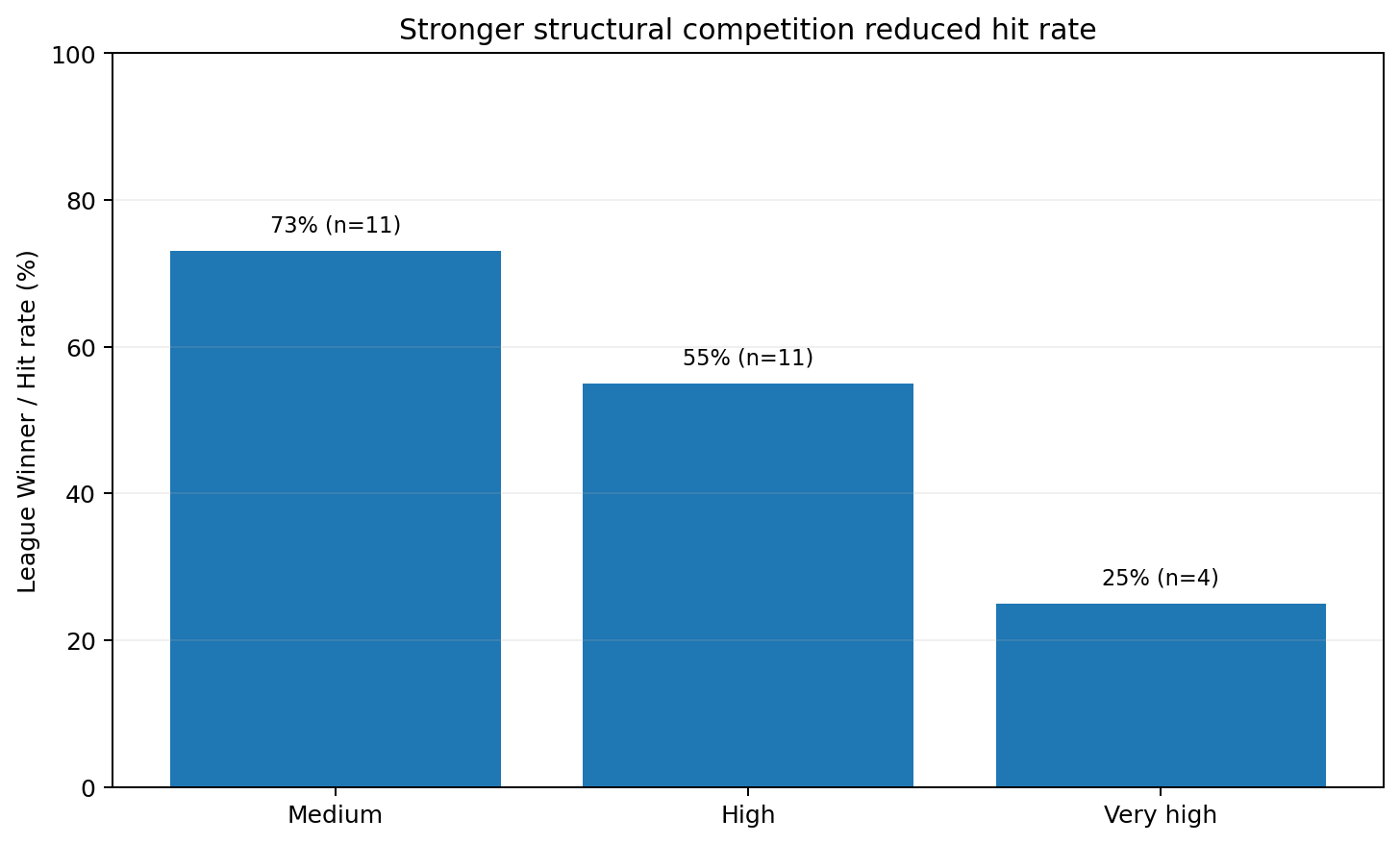
FIGURE 1. Stronger structural competition correlated with a lower League Winner/Hit rate in the audited sample.
In our audited sample, only one of the four evaluable cases facing Very High structural competition ultimately became a Hit. None became League Winners. That’s a small sample. It is not a universal law. But it’s a good reminder that ‘he got 18 touches’ and ‘he is likely to continue getting 18 touches’ are two completely different statements.
Volume Matters. It Just Doesn’t Finish the Analysis.
Every League Winner in our study showed meaningful Week 1 opportunity. That’s important. There is no argument here for ignoring volume.
But here’s the problem: five of seven Busts did too.
Malcolm Brown received 21 touches. Dylan Sampson received 20. Isaiah Likely received 12 targets. The workload was not imaginary.
That means ‘chase volume’ is better advice than ‘chase fantasy points,’ but it still isn’t enough.
ROLE EVIDENCE → OWNERSHIP → VACANCY DURATION → COMPETITION → USAGE QUALITY → PRODUCTION
The fantasy points come last. Because once we know that a player is actually on the field, actually receiving the football and actually likely to keep that role, the points become useful confirmation. Without those things, the points can be a trap.
The Injury Question Is More Complicated Than “Next Man Up”
Some of the best waiver-wire pickups happen because somebody else gets hurt. That’s not a flaw in the breakout. It’s often the entire point.
Puka’s initial opening came because Kupp was hurt. Elijah Mitchell became the priority San Francisco back after Raheem Mostert’s injury. Jeff Wilson’s value changed when Elijah Mitchell went down. Nyheim Hines gained opportunity when Marlon Mack tore his Achilles.
So we split injury-created opportunity into a more useful question: How secure is the opening?
There is a huge difference between ‘the starter tore his Achilles and is done for the season’ and ‘the starter rolled his ankle in the third quarter and we don’t know if he’ll miss next week.’ Those both create Week 1 opportunity. Only one clearly creates future opportunity.
To make that distinction explicit, I grouped injury openings by what was actually known on Tuesday: Confirmed multiweek+ meant an absence of several weeks or longer was already established; Uncertain on Tuesday meant the injury created an opening but its length was still unresolved; Short-term / return expected meant the displaced player was expected back relatively soon; and No injury opening meant the waiver case was not being created by an injury vacancy at all.
That distinction produced one of the cleanest signals in our audited sample. All five evaluable cases in which Tuesday morning already confirmed a multiweek-or-longer injury opening ultimately became either League Winners or Hits. The sample is only five because these situations are genuinely uncommon: Week 1 has to create a clearly extended opening behind a player who is still widely available. Five cases are nowhere near enough to declare a fantasy law. They are enough to make the pattern worth testing.
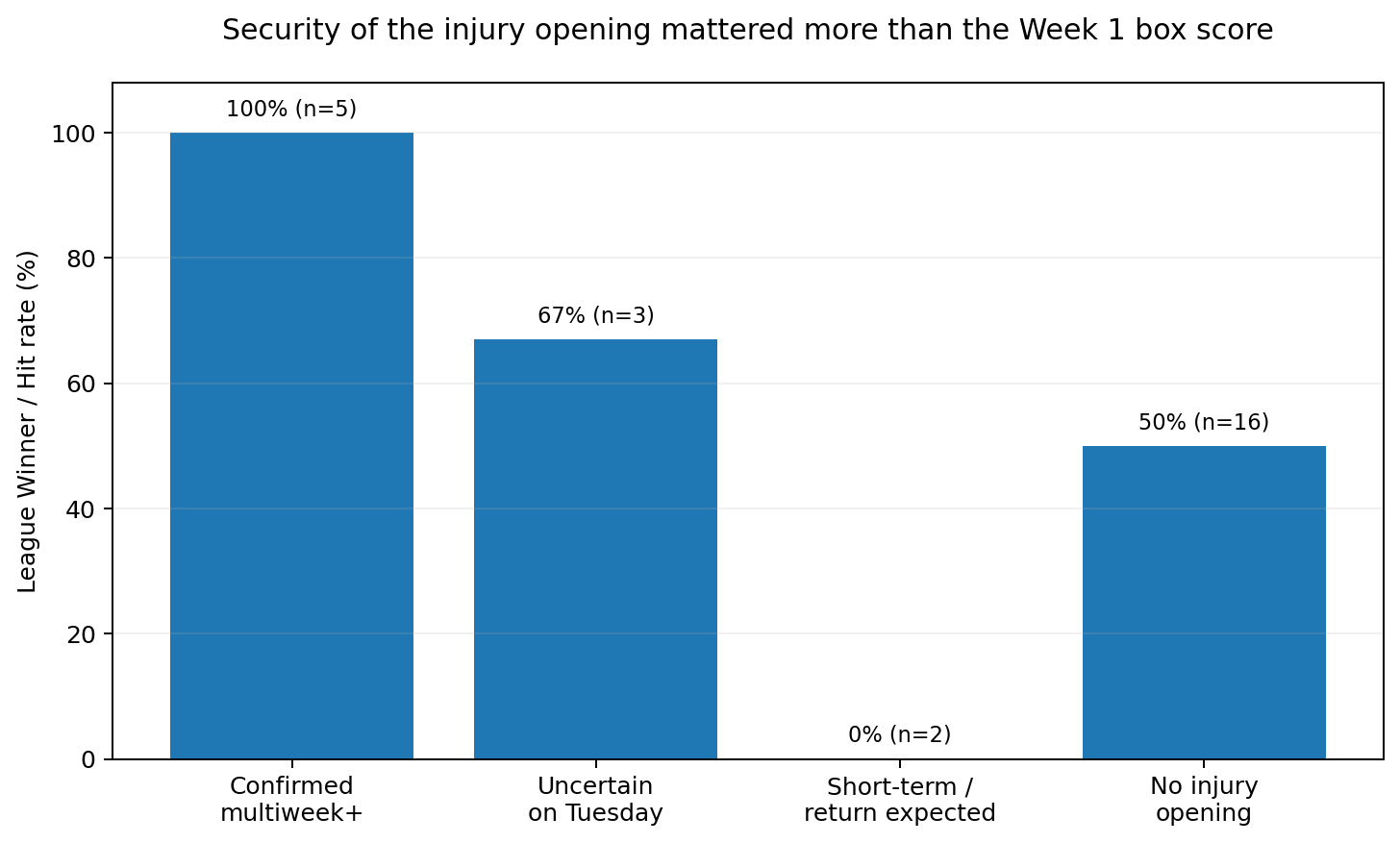
FIGURE 2. Confirmed multiweek injury openings were the strongest clean Tuesday-morning signal in this selected sample.
Now compare Elijah Mitchell and Benny Snell.
Mitchell handled 19 carries in Week 1 of 2021. Raheem Mostert was subsequently lost for the season, and rookie Trey Sermon had been a healthy scratch.
That isn’t merely ‘backup played well.’ That’s major vacancy + workload + evidence the player is ahead of another presumed competitor.
Benny Snell’s 2020 opener looked almost as convincing in the box score: 19 carries for 113 yards after James Conner left with an ankle injury. The volume was real. The permanence of the opening was not. That is PARTIAL, not MIRAGE: meaningful opportunity had appeared, but Tuesday morning had not established that the job would still be open once Conner’s status clarified.
The workloads looked similar. The security of the opening did not.
INJURY OPENINGS: VOLUME ISN’T ENOUGH
| PLAYER | WEEK 1 / TUESDAY CONTEXT | ROLE VERDICT | SEASON RESULT |
|---|---|---|---|
| Elijah Mitchell • 2021 | 19 carries • Mostert lost for season • Sermon healthy scratch | REAL | Hit |
| Benny Snell • 2020 | 19 carries • Conner injury duration still unclear Tuesday | PARTIAL | Bust |
Similar rushing volume, very different evidence about how long the opening would exist and who owned it.
That’s why injury-based waiver analysis should start with: How secure is the opening, and how long is it expected to last? Then: Who appears to own the room while it is open?
Touchdowns Were Much Less Predictive Than Expected
It’s tempting to look at a player who scored twice in Week 1 and immediately apply the dreaded ‘touchdown regression’ label. Sometimes that’s useful. But touchdown dependence by itself did almost nothing to separate our outcome groups.
Kyren Williams is the perfect warning against oversimplifying this. He scored twice in Week 1 of 2023. Yes, those touchdowns inflated his fantasy score. But that’s not what mattered.
The important information was that Williams played roughly two-thirds of the offensive snaps, was heavily involved in the passing-game structure and had clearly gained meaningful standing relative to Cam Akers. Akers’ raw 22-carry total was also inflated by late-game clock-killing work while Los Angeles protected a sizable lead.
So ‘he scored two touchdowns’ wasn’t the analysis. Neither was ‘ignore him because the touchdowns will regress.’
The useful question was: What did the touchdowns sit on top of?
THE BOX SCORE CAN BE LOUD; THE ROLE HAS TO ANSWER
| PLAYER | LOUD RESULT | UNDERLYING ROLE EVIDENCE | VERDICT / OUTCOME |
|---|---|---|---|
| Kyren Williams • 2023 | 17.4 PPR • 2 TD | ~Two-thirds of snaps; major role gain versus Akers | REAL → League Winner |
| Isaiah Likely • 2024 | 26.1 PPR • TE1 | 12 targets, but Mark Andrews remained heavily involved | PARTIAL → Bust |
| Christian Kirk • 2021 | 24.0 PPR • 2 TD | Only 5 targets; behind Hopkins and A.J. Green | MIRAGE → Hit |
The verdict is about Tuesday evidence, not a promise about the season. Kirk is the useful false negative.
Box-Score Breakouts Were One of the More Dangerous Archetypes
This is where the Week 1 trap becomes clearest.
When a waiver case rests mostly on the fantasy result — a big number, a couple of touchdowns — rather than on evidence the player’s job actually changed, the framework is built to be at its most skeptical. That skepticism is the point. It will occasionally cost us a hit, as it did with Kirk, but it is the most reliable way to avoid paying full price for a good afternoon.
Christian Kirk is one of our most important counterexamples. He opened 2021 with five catches for 70 yards and two touchdowns, producing 24 PPR points. But he had only five targets and remained behind DeAndre Hopkins and A.J. Green in Arizona’s receiving hierarchy.
Our Tuesday-only framework calls that a MIRAGE. Kirk eventually finished WR26 and became a Hit.
Was the framework wrong? Not really. It said Tuesday morning did not yet provide strong evidence that Kirk’s role had fundamentally changed. That’s true.
What happened afterward is that football kept happening. Players can earn bigger roles. Teammates can decline. Coaches can change usage. A MIRAGE can become real later.
The goal of this framework is not to pretend we can see the future. The goal is to decide: How much evidence do I have when I have to place the waiver claim?
The Role Verdict
Every major Week 1 waiver candidate gets one of three Tuesday-morning verdicts.
REAL: Week 1 revealed strong evidence of a meaningful, sustainable role. That does not mean future fantasy star. It means the role itself is supported.
PARTIAL: Week 1 revealed meaningful opportunity, but ownership or durability remains unresolved. The workload itself can be completely real — even large — while a temporary injury opening, established incumbent, major draft investment or unresolved committee keeps us from saying the job belongs to the player.
MIRAGE: The Week 1 fantasy result is substantially louder than the underlying role evidence. Think limited playing time, weak target/touch participation, no meaningful depth-chart movement, or production driven heavily by touchdowns and big plays. MIRAGE is about the box score overstating the job — not merely about a real workload sitting on top of an uncertain opening.
| REAL | PARTIAL | MIRAGE |
|---|---|---|
| The role changed. | The role is meaningful; ownership or durability is unresolved. | The box score is louder than the role. |
| • Starter-level snaps/routes • Strong carry/target volume • Depth-chart movement • Opportunity looks sustainable | • Real snaps/touches/targets • But opening may be temporary • Or major competition remains • Ownership is not yet settled | • Limited snaps/routes • Weak underlying opportunity • No meaningful hierarchy change • TD/big-play dependence |
| Puka Nacua, 2023 15 targets with Cooper Kupp out. The opportunity was unmistakable. | Malcolm Brown, 2020 21 touches, but Cam Akers and Darrell Henderson remained. The workload was real; ownership wasn’t. | Christian Kirk, 2021 24 PPR points and two TDs, but only five targets and roughly 55% of snaps. |
| Tuesday action: BUY | Tuesday action: INVESTIGATE | Tuesday action: BE CAREFUL |
THE ROLE VERDICT: The question is not whether the Week 1 performance was real. It is whether the opportunity was.
After applying that cleaner boundary to all 30 historical cases, the sample breaks down as 12 REAL, 17 PARTIAL and just 1 MIRAGE. That lopsided distribution is not a bug. These were already prominent waiver targets, so most had shown something meaningful. MIRAGE should be difficult to earn.
Most major waiver candidates aren’t obvious frauds. That’s why they become waiver candidates in the first place. The real challenge is distinguishing strong evidence from interesting but incomplete evidence.
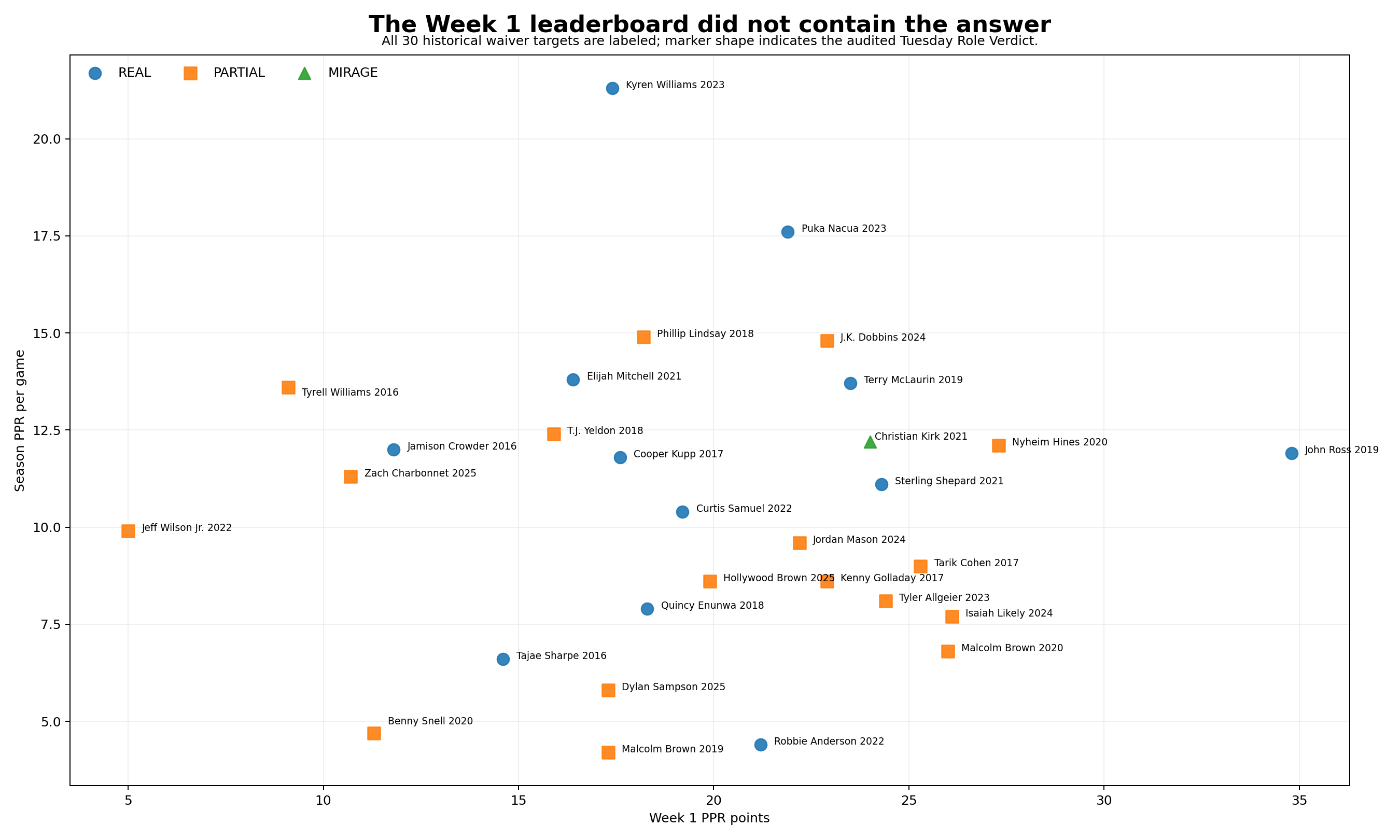
Now that the labels mean something, the original scatter plot becomes more useful. The colors are not outcomes; they are diagnoses of what Tuesday morning actually told us about the role.
FIGURE 3. Week 1 PPR versus subsequent season PPR per game for the 30-player historical sample.
Seen in that order, the chart is less about predicting the final season and more about showing why Week 1 fantasy points alone cannot tell us which roles are trustworthy.
From Diagnosis to Waiver Action
The Role Verdict and the decision tree are not trying to answer the same question. The Role Verdict is the diagnosis: what did Week 1 actually reveal about the player’s job? The decision tree is the prescription: given that diagnosis, how aggressively should we act on waivers?
That distinction matters most with PARTIAL players. Two players can both have meaningful new opportunity and still deserve completely different waiver bids. A PARTIAL player with a secure opening and a disrupted hierarchy can be worth chasing. A PARTIAL player with an elite incumbent returning or a committee still intact may belong in Caution. REAL is not an automatic green light, either; a real role can still be low-value or fragile.
REAL / PARTIAL / MIRAGE is the diagnosis. PRIORITY / CONDITIONAL / CAUTION is the prescription.
STEP 1 — DIAGNOSE THE ROLE. Assign REAL, PARTIAL or MIRAGE using Tuesday-morning evidence only. MIRAGE usually starts in CAUTION. REAL and PARTIAL move to the next question — and PARTIAL is where the tree does most of its work.
STEP 2 — TEST THE OPENING. Is the opportunity secure for multiple weeks, or could it disappear immediately because an injury is short-term, a starter is returning, or the Week 1 workload came from an abnormal situation? Fragile opening: lean CAUTION. Secure opening: continue.
STEP 3 — TEST OWNERSHIP AND COMPETITION. Did the player actually disrupt the hierarchy or claim a meaningful share of the job? Is an established star, major draft investment or unresolved committee still capable of taking it back? Strong ownership / manageable competition: continue. Major obstacle: CAUTION or CONDITIONAL.
STEP 4 — PRICE THE UPSIDE. If the role is both secure and valuable enough to matter weekly, call it PRIORITY. If the evidence is promising but one meaningful question remains, call it CONDITIONAL. If the path depends on too many things breaking right, call it CAUTION.
HOW THE TWO LAYERS WORK TOGETHER
| ROLE DIAGNOSIS | WHAT STILL HAS TO BE TRUE | LIKELY ACTION | HISTORICAL EXAMPLE |
|---|---|---|---|
| REAL | Opening persists; role is valuable; no overwhelming obstacle | PRIORITY or CONDITIONAL | Puka 2023 → Priority |
| PARTIAL | Opening, ownership or competition still needs an answer | PRIORITY, CONDITIONAL or CAUTION | Lindsay 2018 → Conditional; Snell 2020 → Caution |
| MIRAGE | Need stronger role evidence than the Week 1 fantasy result provided | Usually CAUTION | Kirk 2021 → Caution, later became a Hit |
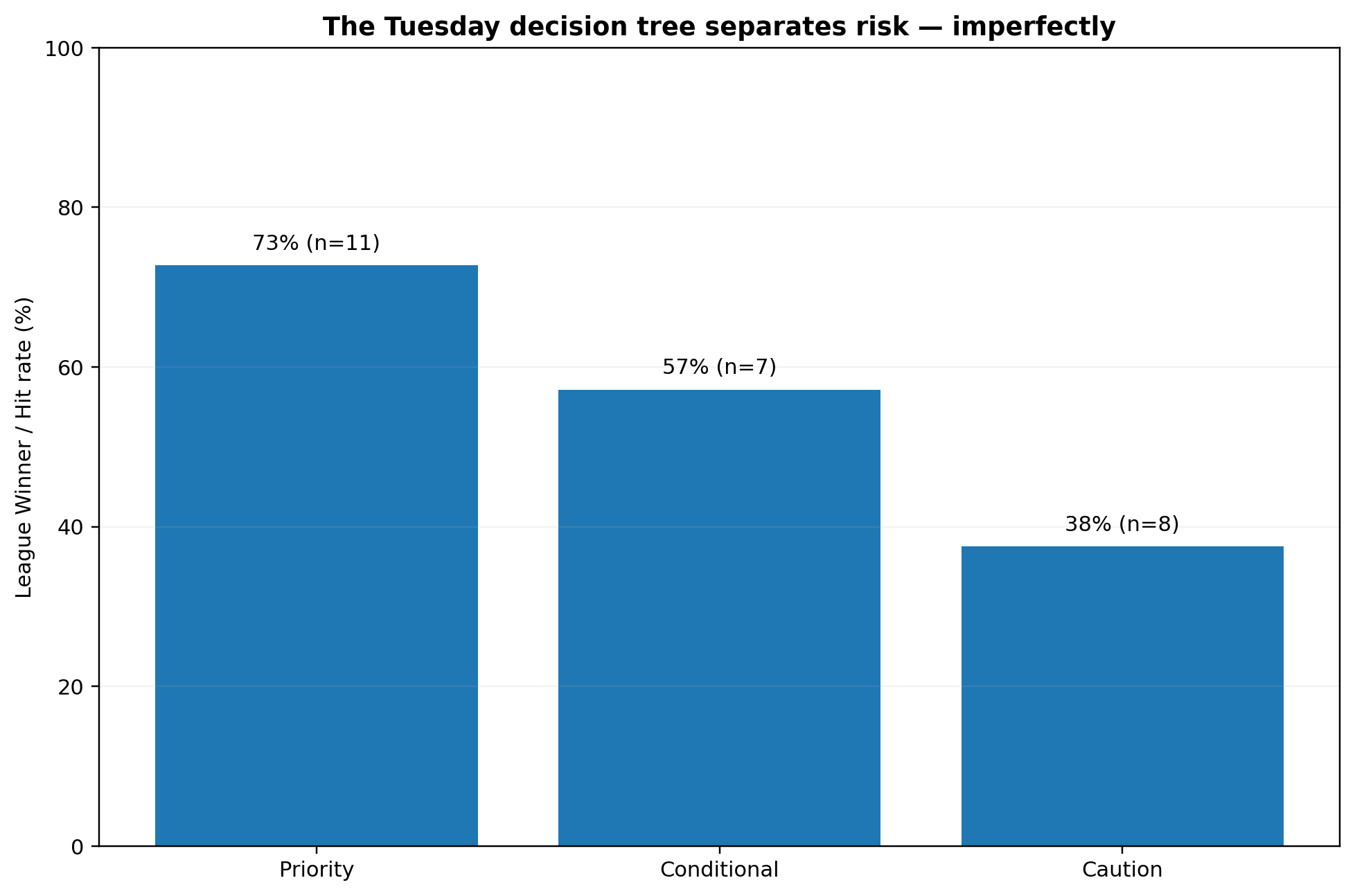
FIGURE 4. Historical performance of the Tuesday-only decision tree. Injury Loss cases are excluded from the evaluable denominator.
Among evaluable cases, Priority went 8-of-11 for League Winner/Hit (73 percent). Conditional went 4-of-7 (57 percent). Caution went 3-of-8 (38 percent). Most importantly, none of the League Winners landed in Caution.
Phillip Lindsay shows why the second layer matters. His Tuesday diagnosis was PARTIAL: Denver’s presumed hierarchy had clearly been disrupted, but Lindsay had not yet proven he owned the backfield. The prescription was therefore CONDITIONAL rather than an automatic Priority bid. Malcolm Brown was also PARTIAL, but his path was shakier because Akers and Henderson remained obvious threats. Same diagnosis, different waiver action.
The Point Isn’t to Eliminate Risk
There is a danger in building any fantasy framework that you eventually start pretending it can solve uncertainty. It can’t. If it could, this would be a much shorter article and I would be significantly more annoying about it.
Tyrell Williams is another useful boundary case. Keenan Allen’s torn ACL created a season-long vacancy, but Williams had only five Week 1 targets and had not yet proven he owned the newly available work. Under the clarified rubric, that is PARTIAL: the opportunity was meaningful, but ownership was unresolved. He later became a Hit. Christian Kirk remains the cleaner MIRAGE example because his 24-point, two-touchdown opener was much louder than his five-target role.
Those are false negatives. They should exist.
The waiver wire isn’t about identifying which players are secretly guaranteed to succeed. It is about deciding where uncertainty is worth paying for.
And after 30 historical cases, our favorite question is now very simple: Did Week 1 reveal new information about who owns the opportunity?
A Necessary Confession About Those Hit Rates
Every number in this section is in-sample, and I want to be the one who says so before anyone else does. The decision tree “went 8-of-11” on Priority cases because the tree itself was built by studying these same 30 outcomes. The five confirmed-multiweek-opening cases all became League Winners or Hits because that pattern was extracted from this same historical sample. That isn’t prediction. It’s description wearing prediction’s clothes.
This is a different problem from small sample size, and it is the more dangerous of the two. A small sample can still point at something real; an in-sample fit is predisposed to look better than it will on new data because the framework was developed with the answers already visible. So do not read Priority-73%-Caution-38% as “this framework hits at 73 percent.” Read it as “this is the shape of what happened in 30 historically prominent Week 1 waiver cases that I identified and graded myself.” The pattern is suggestive. It is not yet evidence that the framework predicts.
The only honest way to find out whether any of this predicts is to freeze it and let it face games it has never seen.
Which is exactly what the rest of this article does.
PART II — THE TEST
Now Let’s Try It Before We Know the Answer
Everything to this point has benefited from hindsight. We know Puka became a star. We know Malcolm Brown did not. We know Phillip Lindsay eventually took control of Denver’s backfield. The harder test is whether any of these lessons are useful before the answer exists.
So this is where the safety net disappears. Before a snap of the 2026 season is played, we are freezing the same kinds of information our historical audit told us to care about and using them to predict the three players most likely to send fantasy managers scrambling to the waiver wire after Week 1.
We are not predicting the three highest Week 1 scorers. We are trying to predict the three available RB/WR/TE players most likely to become the kind of prominent post-Week-1 waiver targets that populated the historical sample. Then, after Week 1, the experiment changes: once we know whom fantasy managers are actually chasing, the Tuesday Role Verdict will ask which of those players they should chase.
Building the Machine: How the Waiver-Frenzy Score Works
The Waiver-Frenzy Score is a weighted ranking framework, not a probability model and not a machine-learning forecast. An 88.2 does not mean Dontayvion Wicks has an 88.2 percent chance to become a top waiver add. It means Wicks earned 88.2 of 100 possible weighted points under six pre-Week-1 criteria. The framework is deliberately simple enough that every grade can be inspected, argued with and graded later.
The model intentionally mixes two ideas. The first four categories ask whether Week 1 can reveal a valuable and sustainable role. The last two ask whether the game itself is likely to produce enough visibility for fantasy managers to notice. That distinction matters: a player can have a fascinating role and still fail to create a waiver frenzy if the box score never attracts attention.
One distinction matters especially for Availability. Being unrostered does not make a player more likely to break out. It makes a breakout more capable of producing a mass Tuesday scramble. A player at 4 percent rostered can create a much larger waiver rush than an equally interesting player already sitting on 45 percent of rosters. Availability is therefore a market-amplification variable, not a football-talent variable.
| Factor | Weight | What it measures |
|---|---|---|
| Role-Reveal Potential | 25% | Can Week 1 reveal a materially different job than the market expects? |
| Availability | 20% | How much room is there for rostership to surge? |
| Opportunity Ceiling | 20% | If the favorable role is revealed, how valuable could it become? |
| Durability | 15% | How likely is that role to survive beyond the immediate week? |
| Matchup / Game Environment | 12% | Does Week 1 give the player a reasonable chance to produce enough to get noticed? |
| Visibility | 8% | How noticeable would a breakout be given the game, team and storyline? |
The grading scale
Role-Reveal Potential, Opportunity Ceiling, Durability, Matchup/Game Environment and Visibility are graded with whole numbers from 1 to 5. We deliberately banned 4.3-versus-4.6 judgment calls in those categories. Availability is the lone exception because its decimal grades are mechanically assigned from ESPN rostership buckets.
A 5 in Role-Reveal Potential means a major starting or lead role is genuinely unresolved and Week 1 can plausibly reveal that the player is winning it. A 4 means a meaningful role can be clarified or expanded. A 3 requires a notable surprise. A 2 means the player’s secondary role is mostly known. A 1 means there is essentially no organic path to a major role change without an injury.
Opportunity Ceiling asks what the job would be worth if the optimistic interpretation is correct: 5 is a feature or elite-volume role; 4 is strong weekly-starter territory; 3 is more flex, committee or secondary-target value; 2 is situational; 1 is minimal.
Durability is intentionally separate from ceiling. A player can have a huge one-week ceiling and a poor durability grade if an established starter is coming back. A 5 means the role should persist if demonstrated; a 4 means it is likely sustainable but competition remains; a 3 means there is a clear threat of reversal or a returning player; 2 is probably temporary; 1 is explicitly short-term.
Matchup and Visibility matter less than role, which is why together they account for only 20 percent of the score. They are there because this model predicts the waiver frenzy, not simply long-term fantasy value. A favorable matchup can help create the Sunday stat line that forces everyone to notice a role change. It cannot make the role real by itself.
Availability is mechanical
For the official experiment, we use ESPN Percent Rostered from the snapshot frozen on September 7. Anyone rostered in more than 50 percent of ESPN leagues is ineligible. Exactly 50 percent remains eligible. The availability grade is assigned automatically: 0-5% = 5.0; 5.1-10% = 4.8; 10.1-20% = 4.4; 20.1-30% = 4.0; 30.1-40% = 3.5; 40.1-50% = 2.5.
That means availability can amplify a candidate’s score, but it cannot manufacture a role. Malik Davis, for example, gets the maximum Availability grade because he is rostered in only 3 percent of ESPN leagues. He still finishes behind the top three because the model is less convinced Week 1 will organically reveal a new lead role while Javonte Williams is healthy.
The formula
Each 1-5 grade is converted to its weighted share of 100 points. In shorthand: Role Reveal x 5, Availability x 4, Opportunity Ceiling x 4, Durability x 3, Matchup x 2.4 and Visibility x 1.6. Add those six contributions and you have the Waiver-Frenzy Score.
Before Anyone Plays: The Frozen 2026 Board
We scored 18 eligible RB/WR/TE candidates. Quarterbacks are kept outside the official pool so the 2026 experiment matches the positions represented in the 30-player historical sample. The ranking below is the frozen pre-Week-1 board, not a list we will reorder after the games.
| # | Player | Tm | Pos | ESPN % | Role | Avail. | Ceiling | Dur. | Match | Vis. | Score |
|---|---|---|---|---|---|---|---|---|---|---|---|
| 1 | Dontayvion Wicks | PHI | WR | 10.1% | 5 | 4.4 | 4 | 4 | 4 | 5 | 88.2 |
| 2 | George Holani | SEA | RB | 3.7% | 5 | 5 | 4 | 3 | 3 | 5 | 85.2 |
| 3 | Malik Washington | MIA | WR | 8.2% | 4 | 4.8 | 4 | 5 | 2 | 4 | 81.4 |
| 4 | Malik Davis | DAL | RB | 3.0% | 3 | 5 | 4 | 3 | 4 | 5 | 77.6 |
| 5 | Caleb Douglas | MIA | WR | 15.9% | 4 | 4.4 | 4 | 4 | 2 | 4 | 76.8 |
| 6 | Kayshon Boutte | HOU | WR | 14.3% | 4 | 4.4 | 4 | 3 | 3 | 4 | 76.2 |
| 7 | Jalen McMillan | TB | WR | 32.3% | 3 | 3.5 | 4 | 4 | 5 | 4 | 75.4 |
| 8 | Gunnar Helm | TEN | TE | 5.7% | 4 | 4.8 | 3 | 4 | 2 | 3 | 72.8 |
| 9 | Terrance Ferguson | LAR | TE | 26.0% | 3 | 4 | 3 | 3 | 4 | 4 | 68.0 |
| 10 | Ryan Flournoy | DAL | WR | 4.1% | 2 | 5 | 3 | 3 | 4 | 4 | 67.0 |
| 11 | Chig Okonkwo | WAS | TE | 8.5% | 2 | 4.8 | 3 | 4 | 3 | 3 | 65.2 |
| 12 | Ja’Kobi Lane | BAL | WR | 17.9% | 2 | 4.4 | 3 | 3 | 4 | 4 | 64.6 |
| 13 | Keaton Mitchell | LAC | RB | 21.4% | 2 | 4 | 3 | 3 | 4 | 4 | 63.0 |
| 13 | Elijah Arroyo | SEA | TE | 0.5% | 2 | 5 | 3 | 3 | 3 | 3 | 63.0 |
| 15 | Juwan Johnson | NO | TE | 45.1% | 2 | 2.5 | 3 | 4 | 5 | 3 | 60.8 |
| 16 | Tre Tucker | LV | WR | 26.5% | 2 | 4 | 3 | 4 | 2 | 3 | 59.6 |
| 17 | Braelon Allen | NYJ | RB | 12.9% | 2 | 4.4 | 4 | 2 | 2 | 3 | 59.2 |
| 18 | Dylan Sampson | CLE | RB | 19.3% | 2 | 4.4 | 3 | 3 | 2 | 3 | 58.2 |
The board also explains why the top three are not simply the three least-rostered players. Ryan Flournoy and Elijah Arroyo are almost universally available, but Week 1 would need to reveal a much larger-than-expected role for either to become a sustainable priority add. Wicks and Holani, by contrast, enter games with genuine unresolved hierarchy questions that can be answered immediately.
Prediction No. 1: Dontayvion Wicks, Eagles
ESPN rostered: 10.1% | Waiver-Frenzy Score: 88.2
| Component | Grade | Weight | Score points |
|---|---|---|---|
| Role-Reveal Potential | 5/5 | 25% | 25.0 |
| Availability | 4.4/5 | 20% | 17.6 |
| Opportunity Ceiling | 4/5 | 20% | 16.0 |
| Durability | 4/5 | 15% | 12.0 |
| Matchup / Environment | 4/5 | 12% | 9.6 |
| Visibility | 5/5 | 8% | 8.0 |
| TOTAL | 88.2 |
Why he is here
Wicks is the No. 1 prediction because his setup combines the exact thing our historical study keeps rewarding – a potentially meaningful hierarchy question – with enough evidence that the optimistic outcome is plausible before Week 1. Philadelphia did not simply add him as a camp body. The Eagles traded a 2026 fifth-round pick and a 2027 sixth-round pick to Green Bay for him in April, and he reunited with offensive coordinator Sean Mannion after their time together in Green Bay.
The opportunity exists because Philadelphia’s receiver room changed dramatically. A.J. Brown is gone. DeVonta Smith is the established No. 1. The Eagles also drafted Makai Lemon in the first round, added Hollywood Brown and Elijah Moore, and entered camp with a legitimate fight for the jobs behind Smith. The team’s own training-camp preview explicitly identified whether Wicks could secure a starting role as one of the position’s central questions.
Then camp started providing evidence. Jeff McLane of The Philadelphia Inquirer wrote on August 5 that Wicks had emerged as the No. 2 receiver while Lemon was sidelined. By the end of camp, PhillyVoice’s Jimmy Kempski was more definitive: Wicks would be the WR2. Wicks also did not play in Philadelphia’s August 15 preseason game, which Kempski interpreted as further confirmation of that status. None of that guarantees a fantasy-useful role, especially with Lemon back, but it makes a major Week 1 role revelation plausible rather than wishful thinking.
Why the model grades him this way
Role-Reveal Potential gets the maximum 5 because the question is not whether Wicks belongs on the roster; it is whether he has actually secured a starter-level receiving job behind Smith. Week 1 can answer that in one afternoon through route participation and personnel usage. Opportunity Ceiling is a 4 rather than 5 because even a clear WR2 role still shares an offense with Smith, Dallas Goedert and Saquon Barkley. Durability gets a 4 because a starting role could last, but Lemon’s return and the presence of Hollywood Brown and Elijah Moore mean the competition has not vanished.
Availability contributes 17.6 of the 88.2 points. At 10.1 percent rostered, Wicks falls into the model’s 10.1-20 percent bucket, worth a 4.4. The favorable Week 1 environment earns a 4, while the Eagles’ prominence and the visibility of a newly established No. 2 receiver earn the maximum Visibility grade. Put it together: 25.0 + 17.6 + 16.0 + 12.0 + 9.6 + 8.0 = 88.2.
The Week 1 matchup
Wicks also gets one of the friendlier Week 1 environments on the board. Washington allowed 206 catches, 2,766 yards and 17 touchdowns to wide receivers in 2025, the most standard fantasy points allowed to the position. The Commanders have since overhauled the defense, so treating last year’s ranking like a prophecy would be lazy even by Week 1 standards. Still, Philadelphia is favored at home in a healthy scoring environment, and the matchup gives Wicks a good chance to show us whether the No. 2 job is actually his. That is a 4, not a 5: favorable, not a free square.
What Sunday has to show us
PRE-FROZEN ROLE VERDICT TRIGGERS — WICKS
The most important number will not be Wicks’ fantasy score. It will be how often Philadelphia treats him like a starting receiver. Our pre-frozen REAL trigger is at least 75 percent route/snap participation and seven targets, with Wicks clearly functioning as one of the top two receivers independent of touchdowns. If he posts six catches for 80 yards on that kind of usage, the model will like the game far more than a three-catch, 70-yard, two-touchdown line on limited routes.
A 50-74 percent role or five to six targets while Lemon, Hollywood Brown and Moore rotate heavily would be PARTIAL. A splash fantasy score on four or fewer targets or limited routes would be a MIRAGE trigger. That’s the whole experiment in miniature: we are predicting Wicks because Week 1 has a chance to tell us he owns a job the fantasy market has not fully priced in.
Prediction No. 2: George Holani, Seahawks
ESPN rostered: 3.7% | Waiver-Frenzy Score: 85.2
| Component | Grade | Weight | Score points |
|---|---|---|---|
| Role-Reveal Potential | 5/5 | 25% | 25.0 |
| Availability | 5/5 | 20% | 20.0 |
| Opportunity Ceiling | 4/5 | 20% | 16.0 |
| Durability | 3/5 | 15% | 9.0 |
| Matchup / Environment | 3/5 | 12% | 7.2 |
| Visibility | 5/5 | 8% | 8.0 |
| TOTAL | 85.2 |
Why he is here
Holani is probably the strangest name in the top three, which is exactly why his Week 1 information value is so high. Seattle enters the season without Zach Charbonnet, who officially opens the year on PUP while recovering from the ACL injury he suffered late last season. The Seahawks used the 32nd pick of the draft on Notre Dame running back Jadarian Price. General manager John Schneider said Price stood alone as the best player left on Seattle’s board. On draft capital alone, the obvious assumption would be that Price takes over.
The Seahawks have spent the summer giving us a much messier picture. Their offseason recap said Price was splitting time with the No. 1 offense but that Holani was usually the first back up. The team’s initial 53-man roster analysis then said Price and Holani figure to split the workload early. And Seattle’s current official depth chart lists Holani first, Price second and Emanuel Wilson third.
Those facts do not prove Holani is the lead back. They prove we do not know. That is the point. Holani is not our No. 2 candidate because we think he is secretly Seattle’s bell cow. If we already knew that, there would be nothing for Week 1 to reveal. He ranks this highly because the market, the depth chart and the underlying football signals disagree – and Sunday can resolve that disagreement very quickly. Our historical audit suggests the most valuable Week 1 information often comes when a game destroys a preseason assumption about the hierarchy.
Why the model grades him this way
Holani gets a 5 in Role-Reveal Potential because Week 1 can directly answer a major backfield question. He gets a 5 in Availability because 3.7 percent rostered falls in the model’s <=5 percent bucket. That perfect Availability grade needs to be read correctly: being rostered in 3.7 percent of leagues does not make Holani a better football bet. It means that if Seattle reveals a meaningful role, almost the entire fantasy market will be able to chase him at once. Opportunity Ceiling is a 4: winning this competition could create a strong weekly role, but the Price investment and Charbonnet’s eventual return keep us from calling it a feature-back ceiling. Durability is a 3 for the same reason.
The matchup is a 3 rather than a reason for the pick. Seattle being favored at home helps the possibility of rushing volume, but the backfield split matters far more than the opponent. Visibility is a 5 because a clear Holani-over-Price result would become one of the most obvious Week 1 depth-chart stories in fantasy. The math is 25.0 + 20.0 + 16.0 + 9.0 + 7.2 + 8.0 = 85.2.
The Week 1 matchup
Holani’s matchup is much less inviting on paper, which is why his grade stays at 3. New England allowed only 1,311 rushing yards and eight rushing touchdowns to running backs in 2025, just 14.1 standard fantasy points per game to the position. Seattle is nevertheless favored at home in the standalone opener, so there should be enough rushing volume to expose the Holani-Jadarian Price hierarchy. In other words: this is not a matchup we love for production; it is a matchup we may love for information. If Holani clearly leads the backfield against a good run defense, that tells us more than a random goal-line plunge ever could.
What Sunday has to show us
PRE-FROZEN ROLE VERDICT TRIGGERS — HOLANI
Our frozen REAL trigger requires Holani to lead Seattle’s running backs in snaps and receive at least 12 touches, plus either three targets or meaningful goal-line work while Price is active. That is intentionally stricter than ‘Holani scores a touchdown.’ We want evidence Seattle trusts him in valuable situations and that the depth chart is more than ceremonial.
If Holani plays roughly 35-50 percent of the snaps and gets eight to 12 touches while Price also has a large role, that’s PARTIAL: interesting committee evidence, but not ownership. If Price clearly leads the snaps and touches while Holani happens to score on limited work, that’s the exact kind of Week 1 box-score trap this article is arguing against.
And if Price dominates? Then the prediction loses. That’s useful too. We are not calling Holani the Seattle RB1 before Week 1. We are saying his 3.7-percent rostership badly understates how valuable the answer to Seattle’s backfield question could become if the answer is Holani.
Prediction No. 3: Malik Washington, Dolphins
ESPN rostered: 8.2% | Waiver-Frenzy Score: 81.4
| Component | Grade | Weight | Score points |
|---|---|---|---|
| Role-Reveal Potential | 4/5 | 25% | 20.0 |
| Availability | 4.8/5 | 20% | 19.2 |
| Opportunity Ceiling | 4/5 | 20% | 16.0 |
| Durability | 5/5 | 15% | 15.0 |
| Matchup / Environment | 2/5 | 12% | 4.8 |
| Visibility | 4/5 | 8% | 6.4 |
| TOTAL | 81.4 |
Why he is here
Washington is a different archetype from Wicks and Holani. We are not waiting to discover whether he made the starting lineup. Miami already lists him as a starting receiver alongside rookie Caleb Douglas and Jalen Tolbert, and the Dolphins also list him first at both kick returner and punt returner. The question is whether that starting designation represents a materially expanded, fantasy-relevant offensive role.
The preseason evidence is unusually useful. PFF’s Week 1 preseason review found that Washington and Douglas were the clear top two receivers with Miami’s starters. Both played every snap in 11, 12 and 21 personnel on the first-team drive. That matters because Washington’s 2025 usage had been much more slot-dependent: PFF charted him on 93.4 percent of Miami’s 11-personnel snaps but only 37.6 percent of the two-receiver snaps. Staying on the field when Miami removes the third receiver is exactly the kind of role expansion that can turn a gadget/slot player into an every-down target.
Washington caught all three of his preseason targets for 15 yards, then did not play in either of Miami’s final two preseason games. PFF’s final preseason assessment expected him to play Z in two-receiver sets and move into the slot in three-receiver sets, calling him the Dolphins receiver with the best fantasy outlook entering the season. The official depth chart now supports the basic premise: he is a starter.
Why the model grades him this way
Role-Reveal Potential is a 4, not 5, because Washington’s starting status is less mysterious than Wicks’ exact pecking order or Seattle’s backfield. What Week 1 can reveal is the quality and breadth of that role: does he actually stay on the field in two-WR personnel, and does Malik Willis look to him consistently? Opportunity Ceiling is a 4 because a full-time receiver who can add designed rushing touches has real weekly upside. Durability is the maximum 5 because, unlike Holani, there is no injured incumbent whose scheduled return automatically threatens the role if Washington proves he owns it.
Availability is nearly perfect at 8.2 percent rostered, producing a 4.8 grade and 19.2 score points. The matchup/environment is the major drag: a low projected game total and questions about Miami’s passing volume under Willis earn only a 2. Visibility is a 4. The final calculation is 20.0 + 19.2 + 16.0 + 15.0 + 4.8 + 6.4 = 81.4.
The Week 1 matchup
Washington’s 2 in Matchup/Game Environment needs a little unpacking, because Las Vegas itself was not a shutdown matchup in 2025. Raiders opponents completed 68.5 percent of their passes, and wide receivers posted 210 catches for 2,503 yards and 16 touchdowns against them. The bigger concern is Miami: a low-scoring road environment, major questions about passing volume with Malik Willis, and an overhauled Raiders secondary that makes last year’s numbers useful context rather than gospel. This grade is about the chance of a waiver-frenzy box score, not whether Las Vegas employs scary cornerbacks. For Washington, routes and targets matter more than whether one ball happens to land in the end zone.
What Sunday has to show us
PRE-FROZEN ROLE VERDICT TRIGGERS — WASHINGTON
The cleanest signal is route participation in two-receiver sets. Our frozen REAL trigger is at least 75 percent route/snap participation and seven targets, or at least six targets plus multiple designed rushes. We want evidence that Washington is not merely the nominal slot starter; we want an every-down offensive role with touches that can repeat.
Starter-level routes but only four to six targets, or a substantial split with Douglas and Tolbert, would be PARTIAL. A long touchdown on sparse routes and low target volume would be MIRAGE territory. Washington could score fewer fantasy points than another waiver candidate and still be the better pickup if Miami shows us the role is stable.
Why These Three – And Why Not the Next Four?
The separation is not enormous, which is another reason to publish the whole board. Week 1 has been known to ignore spreadsheets.
Davis gets enormous credit for 3 percent availability and a favorable Week 1 environment, but his Role-Reveal grade is only 3 because Javonte Williams enters the season as Dallas’ clear veteran No. 1. Davis can absolutely force a committee, but a major organic change requires more surprise than it does for Holani. His easiest path to instant must-add status is a Williams injury, which belongs on the Injury Chaos side of the experiment rather than our main prediction.
Douglas is the closest direct alternative to Washington. Miami drafted the 6-foot-4 receiver in the third round, lists him as a starter, and PFF found that he played every snap with the first-team offense across multiple personnel groupings in the preseason opener. He has a more obvious splash-play and touchdown path than Washington. We rank Washington slightly higher because the veteran’s role looks more versatile and more secure across formations, while Douglas still has competition for outside snaps. If Douglas posts four catches for 90 yards and a touchdown while playing every snap, he can pass Washington immediately after Week 1 – and the framework will tell us why.
Boutte’s appeal comes from an injury-created opening in Houston, but assimilation and role durability are less certain entering his first game with the team. McMillan has a strong ceiling and an excellent game environment, but his higher 32.3 percent rostership leaves less room for the kind of waiver stampede we are specifically trying to predict. Those distinctions are why this is a Waiver-Frenzy Score rather than a rest-of-season player ranking.
The Injury Chaos Clause
Of course, football retains veto power over all of this. We can spend 10 years studying how secure an injury-created opening is and a starting running back can turn the entire Week 2 waiver wire into rubble at 1:17 p.m. Sunday. A receiver can pull a hamstring in the first quarter. A depth chart that looked settled at 12:59 can be irrelevant by 1:30. There is no responsible preseason model for that.
Our three official predictions therefore focus on players who can generate a waiver-worthy role without requiring a new Week 1 injury. Separately, the Injury Chaos Board identifies low-rostered backups who could crash the top three if a new vacancy appears: Ray Davis, Tank Bigsby, Brian Robinson Jr., Emmett Johnson, Kaelon Black, Malik Davis, Keaton Mitchell, Braelon Allen, Samaje Perine and Seth McGowan.
The fair question will be the same one our historical audit asks: once the opening exists, what evidence do we have that this player owns it, and how secure is that opening?
Then We Freeze the Tape
The point of publishing those trigger lines now is simple: Tuesday’s Role Verdict will be judged against criteria written before kickoff, not reverse-engineered after we see the box scores.
The experiment gets graded twice. First, did we correctly predict the waiver frenzy? Our frozen pre-Week-1 top three are Dontayvion Wicks, George Holani and Malik Washington.
After Week 1, we will identify the three actual major waiver targets. Using only the information available Tuesday morning, each will receive a Role Verdict: REAL, PARTIAL or MIRAGE. Then we will make the second prediction: League Winner, Hit, Useful, Bust or Injury Loss.
And then we leave it alone. No retroactive grading changes. No pretending that something we learned in Week 5 was obvious in Week 1. If Wicks plays 48 percent of the routes, Holani gets six touches and Washington disappears in two-receiver sets, the predictions failed. If somebody we ranked 14th reveals a massive role, we will say we missed him and examine why.
That is the point of publishing the framework before kickoff. Ten years of hindsight gave us a theory, not a validated forecasting system. Week 1 of 2026 is the first game the framework has to play without already knowing the final score — a deeply inconsiderate arrangement, but a necessary one.
The Thing We’re Actually Looking For
There is a natural temptation after Week 1 to believe the scoreboard has finally answered all the questions we spent the summer debating. Usually it hasn’t. It has just given us better questions.
Why did the player get those touches? Who else was on the field? Did the starter disappear? Did the injured player suffer a one-week problem or a four-month problem? Did the rookie actually pass the veteran? Was the receiver running every route or just happening to catch both of his targets?
Did the team reveal a new role? Or did the player simply have a good game?
Malcolm Brown’s 26-point opener was real. So were his 21 touches. But the Rams had not shown us that the backfield belonged to him.
Puka Nacua scored fewer fantasy points. But 15 targets, an enormous target share and a known multiweek vacancy told us something much more valuable.
That’s the distinction we’re trying to capture.
Week 1 fantasy points tell us what happened. Week 1 roles give us a chance to understand what might happen next.
Don’t chase the points. Chase the change.


One thought on “Stop Chasing Week 1 Points”